
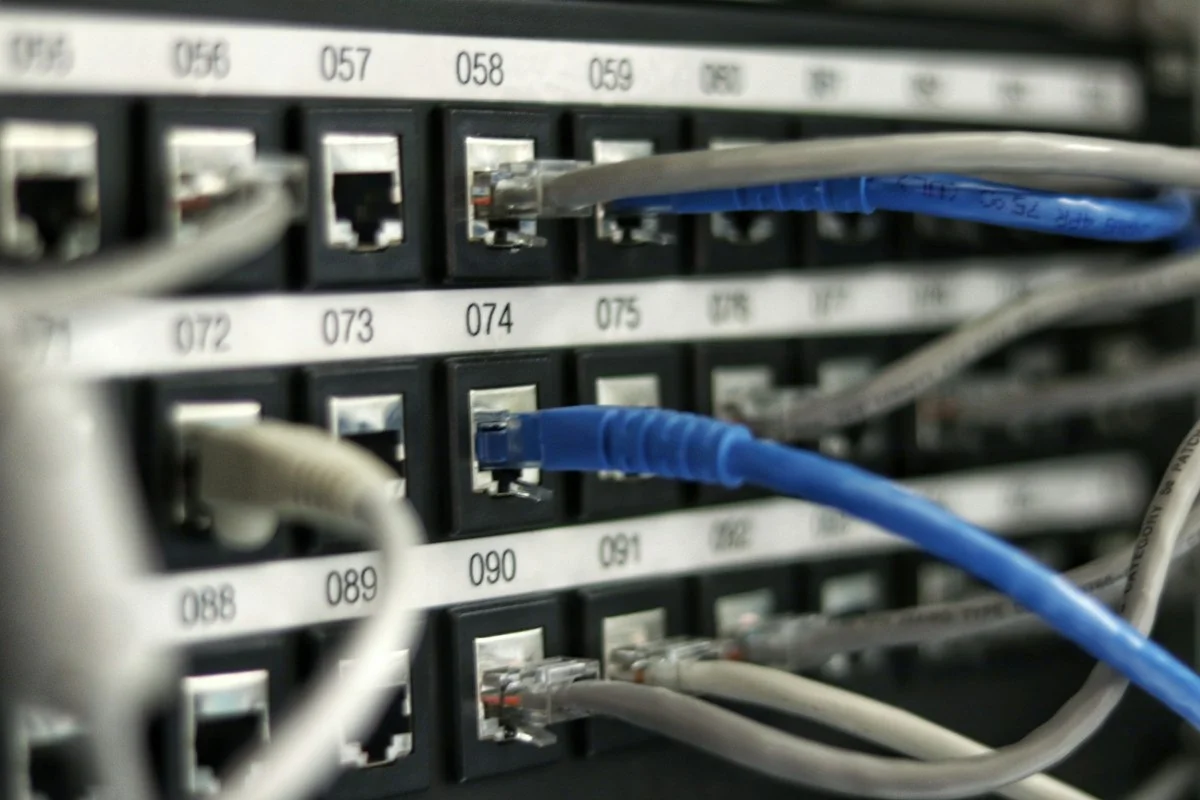
- Power Consumption & Thermals: 10GBASE-T RJ45 copper transceivers draw 2.5W to 4.5W per port and can exceed 70°C, requiring active switch cooling. In contrast, SFP+ Direct Attach Copper (DAC) draws roughly 0.1W to 0.5W, and optical LC transceivers draw approximately 0.8W.
- Transmission Latency: SFP+ DAC cables introduce less than 0.1 microseconds of latency. 10GBASE-T introduces roughly 1.5 to 2.5 microseconds of physical-layer encoding delay due to complex PAM-16 modulation and Low-Density Parity Check (LDPC) error correction.
- Run Length Flexibility: Passive DAC cables are strictly limited to 5 meters. Active optical cables (AOC) and multi-mode OM4 fiber transceivers support runs up to 300 meters without electromagnetic interference. Cat6A copper supports up to 100 meters but requires shielded cable (STP/FTP) to prevent alien crosstalk.
- Network Infrastructure Links: Cross-link with our residential 10GbE structured cabling blueprint and our smart home VLAN segmentation architecture for complete rack integration.
Upgrading a residential homelab or high-performance media server backbone from 1GbE to 10-Gigabit Ethernet (10GbE) is the most impactful hardware upgrade an engineer can undertake. Eliminating the 112 MB/s bottleneck enables uncompressed 4K video editing directly off NVMe storage pools, instant backup synchronization, and seamless VM live migration.
However, many system builders make the costly mistake of assuming that 10-Gigabit networking should use standard RJ45 twisted-pair copper jacks (10GBASE-T). In a server rack environment, 10GBASE-T introduces severe thermal penalties, excessive electrical draw, and fan noise compared to modular SFP+ (Small Form-factor Pluggable Plus) interfaces.
SFP+ vs. 10GBASE-T: What Is the Difference?
SFP+ is superior for rack equipment, servers, and switches because it consumes 80% less power, runs cool, and introduces near-zero latency using passive DAC or fiber. 10GBASE-T is only recommended for long cable runs over pre-existing in-wall Cat6/Cat6A RJ45 wiring where pulling fiber is impossible.
Evaluating the hardware physics illustrates why data centers standardized on SFP+ over a decade ago.
Physical Layer & Engineering Comparison
The table below provides forensic measurements of power dissipation, operational temperatures, and physical transmission boundaries across all 10GbE physical media:
| Physical Layer | Power Draw (Per Port) | Module Operating Temp | Latency | Max Distance |
|---|---|---|---|---|
| SFP+ Passive DAC | < 0.1W to 0.3W | Ambient (< 35°C) | < 0.1 µs | 5 to 7 meters |
| SFP+ Optical (SR / OM4) | 0.6W to 1.0W | 38°C to 45°C | 0.1 µs | 300 meters |
| 10GBASE-T (Native RJ45) | 2.0W to 3.5W | 55°C to 68°C | 1.5 µs to 2.5 µs | 100m (Cat6A) / 55m (Cat6) |
| 10GBASE-T SFP+ Transceiver | 2.5W to 4.5W | 65°C to 78°C | 1.8 µs to 2.8 µs | 30m to 80m (limited) |
The Thermal Reality of 10GBASE-T in a Home Rack
The primary engineering challenge with 10GBASE-T is physical signal processing. Transmitting 10 billion bits per second over four unshielded twisted pairs requires aggressive digital signal processing (DSP) to cancel echo, alien crosstalk, and high-frequency attenuation. The DSP chips inside 10GBASE-T transceivers generate tremendous thermal output.
In fanless switches (such as Mikrotik or Ubiquiti desktop models), plugging four 10GBASE-T RJ45 transceivers side-by-side can cause the switch PHY to throttle or thermal-shutdown. In contrast, SFP+ Direct Attach Copper (DAC) uses twinaxial copper wire to transmit raw digital differential signals directly between switch serializer/deserializer (SerDes) chips with zero active transceiving silicon.
When Should You Use 10GBASE-T RJ45?
Despite its power and thermal disadvantages, 10GBASE-T serves one irreplaceable role: building retrofits. If your home or commercial office was pre-wired with structured Cat6 or Cat6A cabling terminated to wall keystones, pulling new fiber optic micro-ducts through drywall may be economically unfeasible.
In this scenario, utilizing native 10GBASE-T switch ports allows you to connect desktop workstations and Wi-Fi 7 access points at full 10Gbps line rate over existing copper infrastructure.
For server-to-switch and switch-to-switch interconnects inside your equipment rack, standardize exclusively on passive SFP+ DAC cables. For runs between rooms or across building floors, pull OM4 multi-mode LC fiber with 10G SFP+ optical transceivers to eliminate ground loop hum and reduce energy bills. Reserve 10GBASE-T RJ45 transceivers strictly as a legacy fallback for pre-existing in-wall copper runs.