
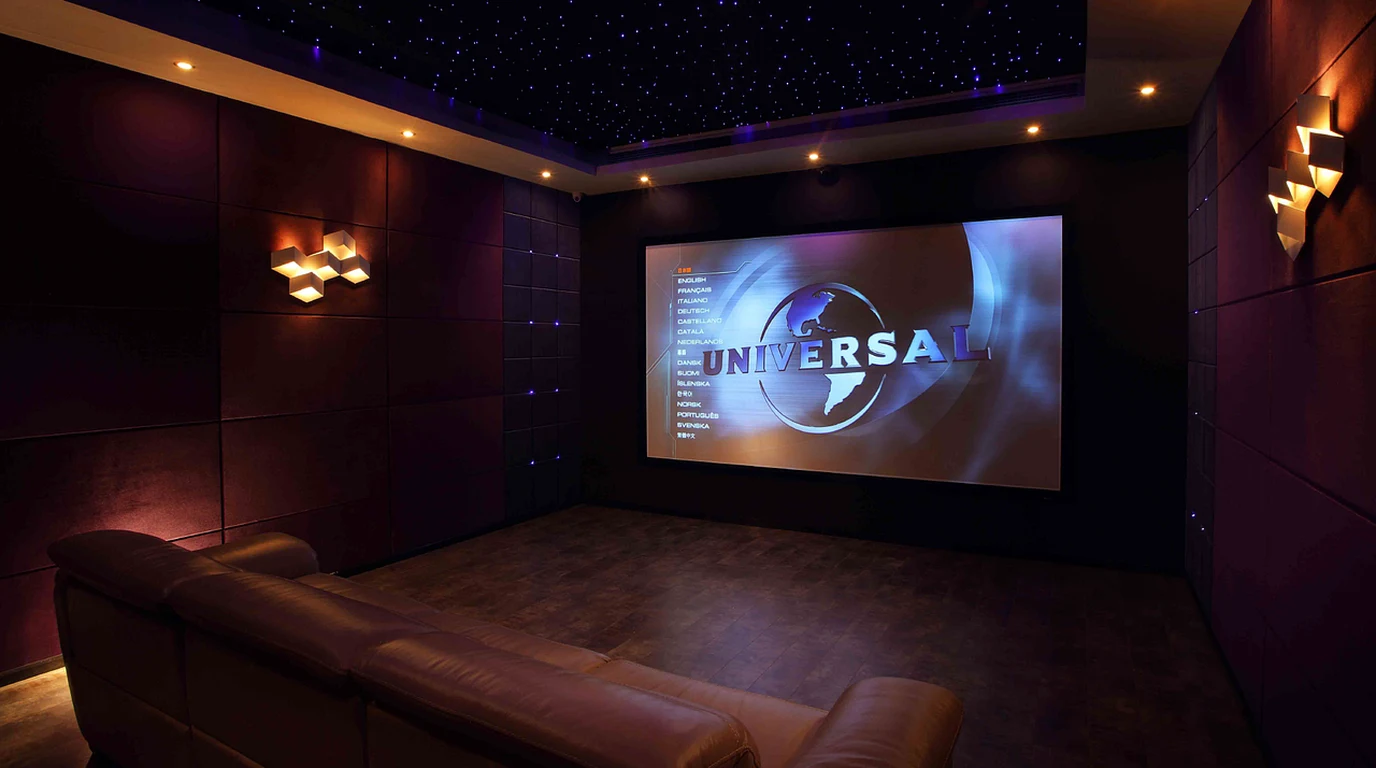
In high-end residential custom acoustics and dedicated luxury home theater design, there is an inescapable physical reality that every acoustic consultant eventually encounters: room acoustics always defeat electronics. You can invest $100,000 in reference-grade monoblock power amplifiers, state-of-the-art beryllium dome tweeters, and four 18-inch neodymium subwoofers, but the moment sound waves leave the speaker cones and enter an enclosed rectangular room, the physical boundaries of that room immediately dictate what your ears actually hear.
Between 20 Hz and 200 Hz—the critical low-frequency spectrum responsible for visceral cinematic impact, chest punch, and tight musical basslines—enclosed rooms are plagued by room modes (standing waves). Standing waves occur when sound waves bounce between opposing walls, ceiling, and floor, colliding with new incoming sound waves. Where these waves arrive in phase, they create massive acoustic peaks (+12 dB to +18 dB of boomy, bloated bass resonance); where they arrive out of phase, they cancel each other out completely, creating deep acoustic nulls (-15 dB to -30 dB of empty, lifeless bass that no amount of amplifier power can equalize).
For decades, solving low-frequency standing waves required extreme physical interventions: building false walls filled with feet of high-density fiberglass, fabricating tuned membrane bass traps that consume thousands of dollars and massive cubic footage of interior living space, or deploying complex multi-subwoofer placement arrays. But with the commercial release of Dirac Live Active Room Treatment (ART), digital acoustic calibration has undergone its most revolutionary transformation in fifty years.
Unlike traditional digital room correction systems (like standard Dirac Live, Audyssey MultEQ-X, or Anthem ARC) that treat each speaker as an isolated channel, Dirac Live Active Room Treatment turns every speaker in your room into an active acoustic absorber. By commanding all speakers to fire anti-phase cancellation signals in precise microsecond synchronization, ART mathematically eliminates standing waves and shortens room decay times without requiring a single cubic inch of physical fiberglass. In this definitive masterclass, we dissect the underlying acoustic physics, hardware requirements, calibration workflows, and real-world performance benchmarks of this game-changing acoustic technology.
How Does Dirac Live Active Room Treatment Actually Work?
Dirac Live Active Room Treatment (ART) transforms all speakers and subwoofers in a surround layout into a unified, collaborative acoustic system. When your front left speaker produces a bass transient, opposing surround and ceiling speakers immediately fire calculated, inverted anti-phase sound waves that neutralize reflections before they can bounce and form standing waves, slashing low-frequency decay times (RT60) below 300ms.
To truly grasp why Active Room Treatment is revolutionary, one must understand the fundamental physical failure of legacy Room Correction EQ. When a traditional equalization system measures an acoustic peak (for example, a +15 dB spike at 45 Hz caused by a length-dimension room mode), it applies a narrow parametric cut filter (IIR/FIR filter) to reduce the amplifier’s electrical output at 45 Hz. While this tames the raw sound pressure level at the listening position, it does nothing to fix the time domain. The sound wave at 45 Hz still bounces back and forth between the front and rear walls for 800 to 1,200 milliseconds before dying out, causing sluggish, ringing, one-note bass that smears midrange vocals.
Even worse is how traditional EQ handles an acoustic null. If destructive interference creates a -20 dB cancellation at 60 Hz at your primary listening seat, boosting that frequency with a parametric equalizer simply feeds more acoustic energy into the cancellation. The null remains just as deep, while your subwoofer amplifier quickly clips, over-excursions the driver, and introduces massive harmonic distortion.
Dirac Live Active Room Treatment rejects the assumption that speakers should only play their own discrete audio channel. In a modern 7.4.4 Dolby Atmos home theater, you have 15 distinct acoustic transducers positioned throughout the perimeter of the room. When the front left speaker plays an explosion, Dirac ART’s MIMO (Multiple-Input Multiple-Output) mathematical engine calculates the acoustic propagation of that wavefront across the three-dimensional room. Milliseconds before the sound wave hits the rear wall, the rear surround speakers and rear height speakers fire targeted, out-of-phase cancellation pulses. The sound wave is absorbed in free air by active destructive interference—precisely replicating the physical effect of a four-foot-thick porous velocity absorber built into the back wall.
The Evolution: Traditional EQ vs Dirac Bass Control vs Dirac ART
Understanding the technological progression across digital acoustic correction systems illustrates why Active Room Treatment represents such a monumental leap forward:
| Acoustic Architecture | Legacy Dirac / Audyssey EQ | Dirac Live Bass Control (DLBC) | Dirac Live Active Room Treatment (ART) |
|---|---|---|---|
| System Topology | SISO (Single-Input Single-Output) | MISO (Multi-Sub Alignment) | Full MIMO (All Speakers Co-Optimize) |
| Frequency Domain Optimization | Parametric EQ Amplitude Cuts | Sub Phase & Delay Splice | Global Soundfield Flattening Across All Seats |
| Time Domain Decay (RT60) | Unchanged (Ringing Persists) | Minor Improvement at Crossover | Massive Decay Reduction (-500ms to -800ms) |
| Hardware Transducers Used | Subwoofers Only for Lows | Multiple Subwoofers | Every Speaker Capable of Playing Down to 150 Hz |
| Physical Room Footprint | Requires 6–12″ Physical Bass Traps | Requires Multiple Sub Placement | Zero Square Footage of Physical Traps Required |
| Spatial Sweet Spot Width | Narrow Primary Listening Seat Only | Full 1–2 Seating Rows | Seat-to-Seat Variance Under 2 dB Across Entire Room |
Hardware Requirements: Supported Processors and Amplifier Headroom
Because Dirac Live Active Room Treatment calculates hundreds of cross-speaker impulse response transfer functions simultaneously, the computational processing requirements far exceed standard AV receiver DSPs. Dirac ART is currently supported on high-performance flagship AV processors and high-tier AVRs, led by StormAudio ISP / I.S.Pro processors, the Marantz AV 10 and Cinema series, and high-tier Denon AVRs (AVR-X4800H, AVR-X6800H, and AVR-A1H) via firmware upgrade licenses.
However, running Dirac ART places severe physical demands on your amplifier power reserves and speaker low-frequency capabilities. To act as an effective acoustic absorber, a surround or rear speaker must be capable of generating acoustic output at the exact frequencies where standing waves need cancellation. If your surround speakers are tiny satellite cubes with 3-inch drivers that roll off sharply at 120 Hz, they cannot cancel a 50 Hz or 70 Hz standing wave. To extract the full power of ART, follow these architectural guidelines:
- Full-Range or High-Output Surrounds: Select surround, wide, and rear channels featuring minimum 6.5-inch or 8-inch mid-bass drivers capable of clean, linear acoustic output down to at least 50 Hz or 60 Hz.
- Dedicated Clean Amplifier Power: Because supporting speakers are now playing both their primary channel content AND cancellation waveforms simultaneously, power draw increases by 3 dB to 6 dB during dynamic transients. Deploy dedicated external multi-channel power amplifiers (Class D Hypex NCore or Purifi Eigentakt modules) delivering minimum 200W to 400W RMS per channel into 4 ohms.
- Multi-Subwoofer Anchors: While ART can work with a single subwoofer, having at least two (or ideally four) active subwoofers positioned in opposing room locations provides the MIMO algorithm with maximum acoustic leverage to eliminate modal energy across the lowest octave (20 Hz to 40 Hz).
Step-by-Step Calibration: The 9-Point Acoustic Mapping Protocol
Calibrating a room with Dirac Live Active Room Treatment requires meticulous physical measurement discipline. A sloppy microphone sweep will corrupt the spatial impulse response calculations, leading to unnatural sound staging. Follow this verified 9-point calibration protocol:
- Prepare the Calibration Environment: Mount a calibrated USB microphone (such as the miniDSP UMIK-1 or UMIK-2) on a rigid boom stand with shock mounts. Never hold the microphone by hand. Eliminate all ambient room noise: shut down HVAC systems, close heavy curtains, and power down noisy server fans.
- Execute Gain Staging in Dirac Software: In the Dirac Live desktop calibration suite, set your master output volume so that the measurement sweep achieves approximately 75 dB to 80 dB SPL at the primary listening seat. Verify that each speaker’s input gain meter sits comfortably in the green zone without clipping the microphone pre-amplifier.
- Capture the Primary Reference Measurement: Position the microphone at the exact ear height of your main listening position (Sweet Spot 1) pointing directly at the ceiling (using the 90-degree calibration file). This first measurement is sacred: Dirac uses it to calculate absolute speaker distances, time delays, and reference phase alignment.
- Map the 8 Surrounding Spatial Points: Move the microphone to the remaining eight measurement locations across a 3D bubble (front-left, front-right, rear-left, rear-right, elevated-left, elevated-right, and mid-flank positions) spaced approximately 18 to 24 inches apart. Never place the microphone within 18 inches of a boundary wall or chair headrest to avoid measuring localized acoustic diffraction.
- Configure Speaker Support Groups in ART: In the Active Room Treatment module, inspect your speaker groupings. Assign your subwoofers and main channels as primary acoustic emitters. For each speaker group, designate which surrounding speakers are permitted to act as Support Speakers. Configure the lower support frequency cutoff based on each speaker’s verified in-room F3 roll-off point.
- Shape Your Target Acoustic Curve: Avoid flat target curves, which sound sterile, thin, and fatiguing to human hearing. Draw a natural, psychoacoustically validated target curve featuring a gradual +4 dB to +8 dB low-frequency shelf boost below 80 Hz, rolling smoothly through the midrange, with a gentle 1 dB to 2 dB roll-off above 10 kHz.
- Calculate and Export Filters to the Processor: Click Calculate to generate the MIMO FIR filter matrix. Once processing completes, inspect the predicted impulse response and energy decay waterfall plots. Export the completed filter set directly into Slot 1 of your AV processor.
Group Delay, Phase Linearity, and Multi-Seat Consistency
Beyond raw frequency response amplitude, the most profound acoustic benefit delivered by Dirac Live Active Room Treatment is the near-total eradication of excess group delay. In acoustic physics, group delay represents the rate of change of phase shift with respect to angular frequency; in simple human listening terms, it measures how many milliseconds a particular bass note lags behind the rest of the audio signal.
In standard domestic listening rooms, high-Q modal resonances cause catastrophic group delay spikes. When a kick drum strikes, the fundamental transient at 40 Hz is delayed by 40 to 90 milliseconds relative to the 2 kHz attack transient of the beater hitting the drum skin. Human psychoacoustic perception registers this physical delay as “slow,” “flabby,” or “disconnected” bass. By applying continuous, micro-timed anti-phase acoustic absorption across all supporting transducers, Dirac ART flattens group delay across the entire 20 Hz to 150 Hz passband, keeping low-frequency phase rotation well below human detection thresholds (under 1.5 cycles).
Furthermore, ART permanently solves the multi-seat acoustic dilemma. In a conventional home theater with two or three rows of luxury recliners, equalizing the primary listening position (Seat 1) inevitably degrades sound quality for friends and family sitting in the flanking seats (Seats 2 through 8). A cut filter applied to tame a peak in the center seat often plunges the adjacent seat into a cavernous acoustic null. Because Active Room Treatment destroys the standing waves at the room boundaries before they can establish spatial interference patterns, the low-frequency acoustic impedance of the entire room is linearized. Measured seat-to-seat sound pressure variance collapses from typical wild swings of +/- 14 dB down to an astonishingly consistent +/- 1.8 dB window across every seat in the theater.
Real-World Verification: Waterfalls and Listening Tests
When you measure the before-and-after results using Room EQ Wizard (REW), the impact of Dirac Live Active Room Treatment is immediately visible on waterfall decay plots. In an untreated room, a typical low-frequency standing wave at 40 Hz rings for over 800 milliseconds, showing up as a long, bloated ridge extending across the waterfall diagram. With Active Room Treatment enabled, that same 40 Hz resonance decays completely within 250 milliseconds—a staggering 70% reduction in temporal acoustic distortion.
Subjectively, the sonic transformation is breathtaking. Bass transients are no longer perceived as coming from distinct subwoofer boxes in the corners of the room; the bass becomes entirely transparent, appearing to emanate directly from the on-screen action with razor-sharp physical precision. Bass drum kick impacts hit with immediate, explosive tactile punch that starts and stops on a dime, leaving the vocal dialogue completely pristine and intelligible even during chaotic action scenes. For luxury homeowners who refuse to clutter their architectural living spaces with bulky foam panels and fabric bass traps, Dirac ART is nothing short of acoustic alchemy.
High-bandwidth video transmission must match reference-grade multichannel acoustic fidelity. Examine our deep dive into 4K HDMI 2.1 Over Fiber vs HDBaseT: Distance Benchmarks.