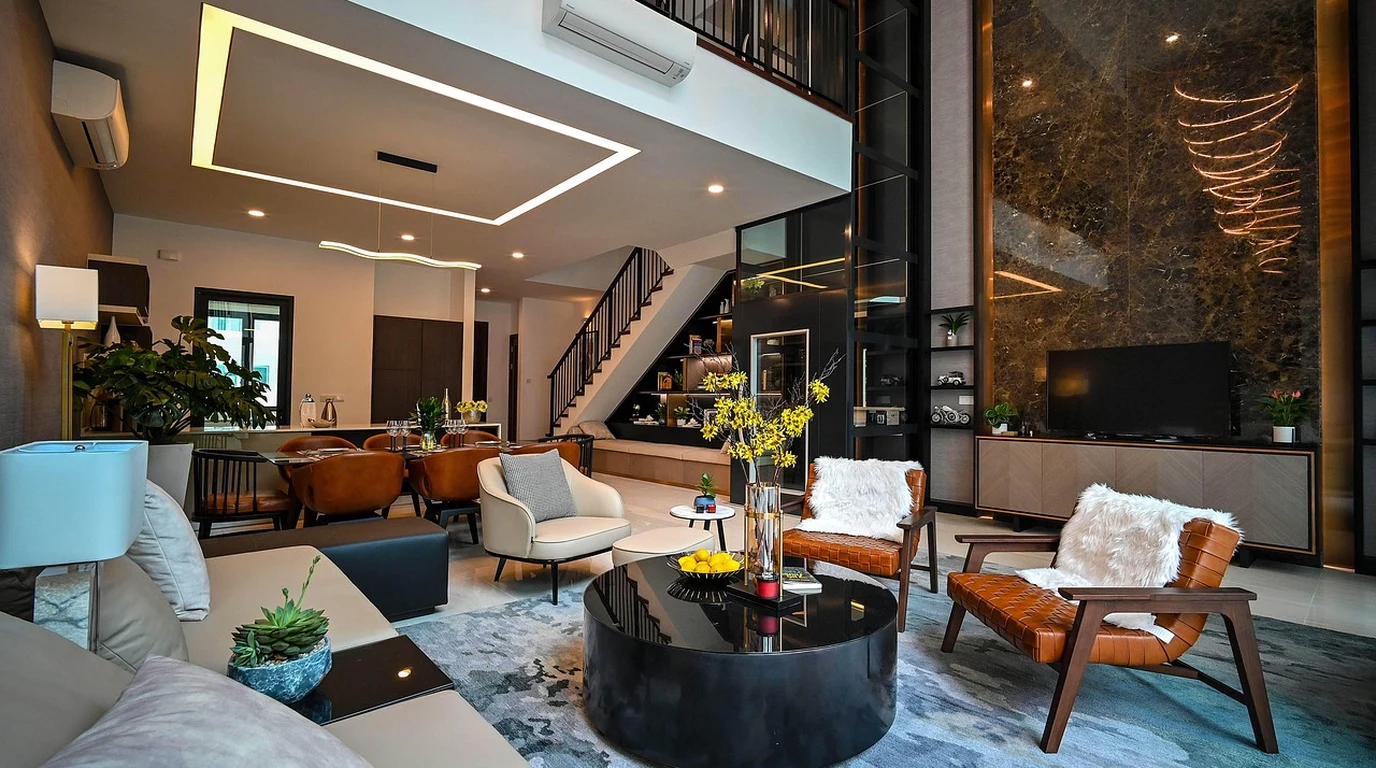
Pulling off a multi-million-dollar architectural build only to watch a client squint because their expensive fixtures look like a greenish hospital hallway at dusk is a quick way to ruin a reputation. We have all been there. You spec high-end custom millwork, pristine Venetian plaster, and statement marble, only for standard architectural lighting to turn those organic textures flat and lifeless as the sun goes down. The real frustration isn’t just about color temperature; it is the agonizing disconnect between the natural circadian rhythm outside the window and the static, lifeless electric light bleeding from the ceiling.
Direct Practical Verdict:
Lutron Ketra eliminates color drift and artificial color shifts by utilizing a custom multi-channel LED driver, optical feedback sensors, and closed-loop calibration. It maps seamlessly across a 1,400K to 10,000K blackbody curve via HomeWorks QSX, delivering true dynamic circadian alignment without manual end-user intervention.
Grab a cup of coffee. Let’s pull back the architectural curtain and look at how Ketra actually works under the hood, why standard tunable white solutions fall short of true luxury expectations, and how you can engineer, program, and commission a flawless natural light tuning system on your next project.
## Why Do Standard Tunable White Systems Look So Flat and Unnatural?
Walk into most high-end residences featuring traditional “tunable white” fixtures, and you will spot the visual failure within seconds. The light feels mechanical, stark, and oddly synthetic. The root cause comes down to the underlying optical physics and the math of white light generation.
Standard architectural fixtures achieve tunable white by blending two or sometimes three static LED channels—typically a warm white phosphor and a cool white phosphor. When you cross-fade between these two points on the CIE 1931 chromaticity diagram, the resulting color vector cuts across a straight chord rather than following the natural Planckian locus, or blackbody curve. The light dips below the daylight curve into greenish-cyan territory during the mid-temperatures, destroying skin tones and skewing wood finishes.
Ketra approaches this completely differently by abandoning standard two-channel mixing in favor of a proprietary multi-channel architecture. By leveraging red, green, blue, warm white, and cool white emitters, the internal driver dynamically mixes precise spectral power distributions in real time. This allows the fixture to track the exact blackbody curve from an intimate 1,400K candlelight all the way up to a crisp, crystalline 10,000K daylight.
More importantly, LEDs are inherently unstable thermal devices. As a diode heats up during normal operation, its phosphor degrades, the forward voltage shifts, and the chromaticity drifts. If you leave an uncalibrated LED running for three years, a 3000K fixture will easily drift toward 3300K or pick up an unappealing magenta tint. Ketra solves this through an embedded optical feedback mechanism known as Color Lock. An internal optical sensor continuously samples the light output inside the mixing chamber, feeding real-time telemetry back to the proprietary processor. If a diode begins to age or shift due to ambient thermal load, the driver auto-corrects the drive currents instantly. The result is absolute color consistency over a 50,000-hour lifespan. No manual recalibration. No customer call-backs.
## How Does Ketra Compare to DALI-2, DMX512, and Consumer Smart Lighting?
When you are defending a six-figure lighting control specification to an uncompromising architect or interior designer, you need to understand the structural trade-offs between competing technologies. Let’s look at how Ketra stacks up against industry alternatives.
| System Architecture |
Color Spectrum Range |
Color Stability & Drift Control |
Ecosystem Integration |
Primary Engineering Vulnerability |
| Lutron Ketra |
1,400K – 10,000K true blackbody & custom gamut |
Closed-loop optical feedback (Color Lock); zero visible drift |
Native Lutron HomeWorks QSX & Clear Connect Type X |
Proprietary ecosystem; strict wiring topologies |
| DALI-2 Tunable White |
Typically 2700K – 5000K (dual-channel phosphor) |
Open-loop; relies entirely on factory binning and driver aging tolerances |
Universal open protocol across commercial lighting vendors |
Noticeable color discrepancies between mixed manufacturer fixtures over time |
| DMX512 RGBW |
Wide RGB spectrum plus static white chips |
Manual calibration required; susceptible to thermal decay |
Requires third-party lighting consoles or complex gateway translation |
Steep programming curve; high risk of flicker at low-end dimming |
| Consumer Smart Lighting |
2200K – 6500K software-emulated white |
None; rapid phosphor degradation |
Cloud-dependent APIs, Zigbee/Matter meshes |
High latency, drops off local network, poor dimming curves below 5% |
The takeaway here is straightforward. DALI and DMX are phenomenal standards for commercial theatrical and office environments, but they treat color tuning as an open-loop math problem. Ketra treats color tuning as a closed-loop biological and optical science.
## What Are the Hardware and Cabling Requirements for a Reliable Ketra Deployment?
You cannot treat Ketra wiring like standard 14/2 Romex or basic low-voltage runs. The system relies on a hybrid topology that marries robust power distribution with wireless mesh communication.
Each Ketra fixture or linear run connects to a dedicated auxiliary power supply (the Ketra Power Supply unit, or KPS). The KPS accepts line voltage (120V to 277V) and outputs a regulated DC power and data stream over a dedicated, low-voltage cable topology. This separation of high-voltage switching from the actual light engine is what allows Ketra drivers to achieve butter-smooth dimming down to 0.1% without stutter, dropouts, or audible ballast hum.
For control communication, Ketra fixtures do not require physical data home-runs back to the processor rack. Instead, they communicate using Lutron’s proprietary Clear Connect Type X wireless mesh protocol operating in the 2.4 GHz ISM band. Every Ketra node acts as an active repeater, dynamically routing packets across the home.
However, high-end residential architecture is notorious for standing in the way of wireless signals. Reinforced concrete shear walls, leaded glass window panes, foil-backed insulation, and subterranean stone basements will chew up RF signals if you do not plan ahead.
When laying out your infrastructure, make sure to:
* Position HomeWorks QSX processors and Clear Connect gateway bridge modules centrally within dense fixture clusters.
* Avoid enclosing power supplies inside unvented, sealed metal electrical boxes deep within concrete soffits where heat dissipation is compromised and RF containment is absolute.
* Verify that your low-voltage cabling runs from the KPS to the fixtures adhere strictly to maximum distance limitations to prevent voltage drop, which can destabilize the high-speed data carrier superimposed on the DC bus.
## How Do You Program Circadian Natural Light Tuning in Lutron Designer?
Hardware installation is only half the battle. The true artistry of a Ketra system lies in the software configuration inside Lutron Designer. This is where you map abstract mathematical color curves to the lived human experience inside the residence.
Circadian tuning should never be a rigid, automated script that forces a bedroom to 6500K blue-enriched light at 11:00 PM just because the sun is up somewhere on the planet. Real human-centric lighting respects the architecture, the client’s geographic coordinates, and their personal routine.
Here is your step-by-step playbook to commission a flawless natural light tuning schedule:
1. **Establish Geographic Anchors and Astronomical Clocks:** Open Lutron Designer and assign the precise latitude and longitude of the residence to the HomeWorks QSX processor. This ensures that sunrise, solar noon, and sunset calculations track precisely with the real-world horizon outside the client’s windows.
2. **Configure the Natural Light Zones:** Group fixtures by architectural exposure. East-facing master suites require a different tuning profile than West-facing media rooms or windowless subterranean wine cellars. Assign fixtures to dedicated Natural Light areas within the software.
3. **Map the Natural Light Curve (NLC):** Customize the time-of-day color temperature and intensity vectors.
* **Morning Ramp (Sunrise to 9:00 AM):** Transition smoothly from 2200K warm amber light up to 4500K to suppress melatonin and signal alertness.
* **Solar Apex (11:00 AM to 2:00 PM):** Peak at 5500K to 6500K to mimic high-noon daylight, maximizing productivity and focus in home offices and kitchens.
* **Evening Wind-Down (Sunset to 9:00 PM):** Drop the color temperature down along the blackbody curve to 2700K and below, stripping out high-frequency blue spectra.
* **Night Mode (9:00 PM to Sunrise):** Clamp output to a deep, warm 1,400K candlelight if activated, protecting circadian pathways for late-night hallway navigation.
4. **Program Aesthetic Overrides and Keypads:** Tie manual wall controls (such as Lutron Alisse or Palladiom keypads) to override scenes without breaking the background circadian track. Ensure that pressing a “Relax” scene gently shifts the zone to a pre-determined warm state, while holding a preset button re-engages the dynamic Natural Light schedule.
5. **Perform On-Site Tuning and White-Glove Audit:** Walk the property at twilight with the interior designer. Use the Ketra handheld commissioning tool to verify that wood grains pop, skin tones look natural, and there are no jarring color jumps as zones cross-fade. Fine-tune transition fade rates—circadian shifts should happen so slowly that the human eye never consciously registers the fixture changing color.
Nail this commissioning process, and you transform electric lighting from a utilitarian utility into an invisible, health-enhancing architectural medium that completely redefines how a luxury home feels.
### Frequently Asked Questions
Can Lutron Ketra fixtures integrate with third-party automation systems like Crestron or Control4?
Yes. While Ketra requires Lutron HomeWorks QSX as its primary native control backbone, HomeWorks features robust, bi-directional IP and serial integration drivers for Crestron, Control4, Savant, and Apple HomeKit. This allows third-party touch panels and voice interfaces to trigger Ketra scenes, adjust intensities, and modify natural light schedules seamlessly.
What happens to Ketra natural light schedules if the home loses internet connectivity?
Nothing. Ketra and HomeWorks QSX do not rely on cloud servers or continuous internet access for their core operational logic. The astronomical clock, circadian algorithms, and scene control instructions run locally on the physical processor hardware installed on-site. Cloud connectivity is only required for remote mobile app access and firmware updates.
How does Ketra achieve dimming down to 0.1% without color shifting or flickering?
Standard LED dimming typically relies on Pulse Width Modulation (PWM) or forward-phase chopping, which can cause visible flicker and color distortion at low levels. Ketra utilizes proprietary DC current regulation paired with multi-channel diode balancing inside the driver. As the overall light output drops, the driver proportionally scales all color channels simultaneously while maintaining strict adherence to the blackbody curve down to a fraction of a percent.