
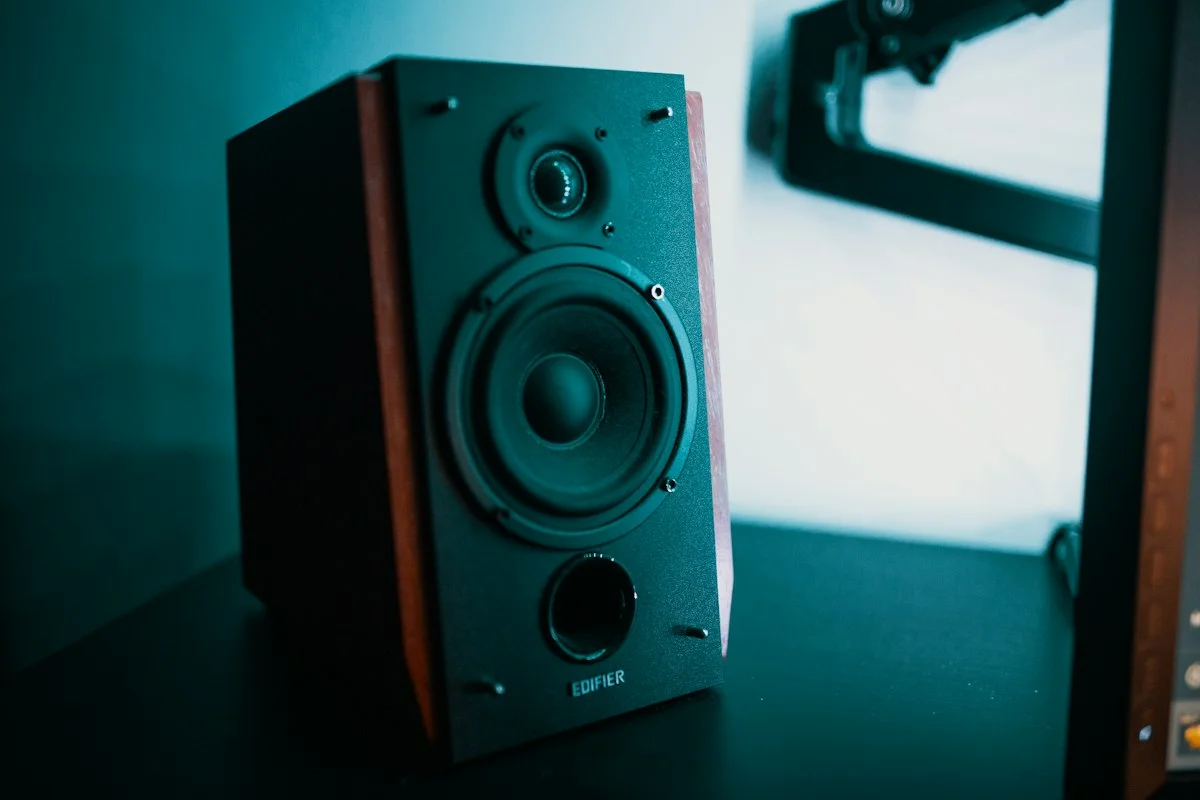
- Low-End Rolloff & Room Gain: Sealed enclosures exhibit a gentle 12dB/octave acoustic rolloff below resonance. In sealed, rigid rooms, natural room gain typically rises at approximately 12dB/octave below 30Hz, creating flat extension down to single-digit frequencies. Ported enclosures roll off steeply at 24dB/octave below their port tuning frequency, resulting in virtually zero infrasonic output.
- Group Delay & Transient Speed: Ported enclosures introduce significant phase rotation and high group delay (often exceeding 20ms to 30ms) near the port tuning frequency due to the Helmholtz resonator resonance. Sealed enclosures maintain low group delay (< 10ms) across the entire audible spectrum, delivering superior musical articulation and “fast” bass.
- Maximum Output & Distortion: Ported subwoofers generate 3dB to 6dB higher maximum sound pressure level (SPL) in the critical 20Hz–40Hz tactile action movie octave with significantly lower driver cone excursion and reduced voice coil distortion.
- Acoustic Tuning Links: Cross-link with our subwoofer phase alignment and REW time delay guide and our home theater acoustic room treatment analysis.
Low-frequency sound reproduction is the most physically demanding aspect of home theater and high-end stereo design. Below 100Hz, sound waves measure between 11 and 56 feet in length, meaning the listening room acts as an acoustic resonator rather than a free-field listening environment. Standing waves create massive peaks and nulls that distort playback.
When selecting subwoofers for a high-performance system, the primary architectural decision is enclosure physics: Acoustic Suspension (Sealed) versus Bass Reflex (Ported). While internet audio forums frequently claim that “sealed is for music and ported is for movies,” the reality is governed by enclosure mathematics, room boundary dimensions, and phase behavior.
Sealed vs. Ported Subwoofers: What Is the Difference?
Sealed subwoofers are superior for smaller, enclosed listening rooms and critical 2-channel Hi-Fi listening because their low group delay and gentle 12dB rolloff integrate cleanly with natural room gain. Ported subwoofers are superior for large, open-concept home theaters because their Helmholtz resonance produces 3dB to 6dB higher output in the 20Hz–40Hz range.
To evaluate which topology fits your listening environment, we must examine group delay and room interaction.
Acoustical & Mechanical Comparison
The following engineering matrix compares physical driver dynamics, acoustic phase response, and practical room behaviors between sealed and ported enclosures:
| Acoustic Parameter | Sealed (Acoustic Suspension) | Ported (Bass Reflex / Vented) |
|---|---|---|
| Low-Frequency Rolloff Slope | 12 dB / octave (2nd order) | 24 dB / octave (4th order) |
| Group Delay at 20Hz | Very Low (< 8 ms) | Elevated (20 ms to 35 ms) |
| Efficiency at Tuning Freq | Baseline reference | +3 dB to +6 dB output boost |
| Cabinet Physical Volume | Compact (1.5 to 3.0 cu ft) | Large (3.5 to 7.0 cu ft) |
| Infrasonic Extension (<15Hz) | Extends deep with room gain | Cutoff by high-pass infrasonic filter |
| Over-Excursion Risk | Protected by air spring damping | Requires subsonic DSP limiter below tune |
The Room Gain Equation: Sealed Enclosure Magic
In an enclosed room with closed doors and solid drywall or concrete walls, low frequencies undergo pressure-vessel room gain below the lowest axial room mode (calculated as c / 2L, where c is the speed of sound and L is room length). In a typical 18-foot long room, room gain begins boosting frequencies below 31Hz at a rate of 9dB to 12dB per octave.
Because a sealed subwoofer rolls off at an inverse 12dB/octave slope, the natural acoustic reinforcement of the room mirrors the subwoofer’s mechanical rolloff. The result is an in-room frequency response that remains ruler-flat down to 10Hz or 12Hz without electronic equalization.
The Volume Displacement Reality of Large Ported Enclosures
Conversely, in large open-concept living spaces (greater than 4,000 cubic feet) or rooms with open hallways, room gain does not occur because sound pressure leaks out of the boundary walls. In these expansive environments, a sealed subwoofer must rely entirely on brute-force driver cone excursion and amplifier wattage.
In large spaces, ported subwoofers are essential. Near the port tuning frequency (typically 16Hz to 22Hz), the air column in the port resonates in-phase with the driver cone, producing massive sound waves while the physical driver cone remains nearly stationary. This dramatically lowers intermodulation distortion during intense movie explosions.
If your listening space is an enclosed room under 3,000 cubic feet or if your listening profile prioritizes 2-channel audiophile playback with tight transient slam, deploy dual sealed subwoofers to leverage natural room gain and maintain sub-10ms group delay. If your room is over 4,000 cubic feet with open floorplans and your primary mission is visceral cinema impact, deploy dual high-output ported subwoofers tuned to 18Hz or lower.