
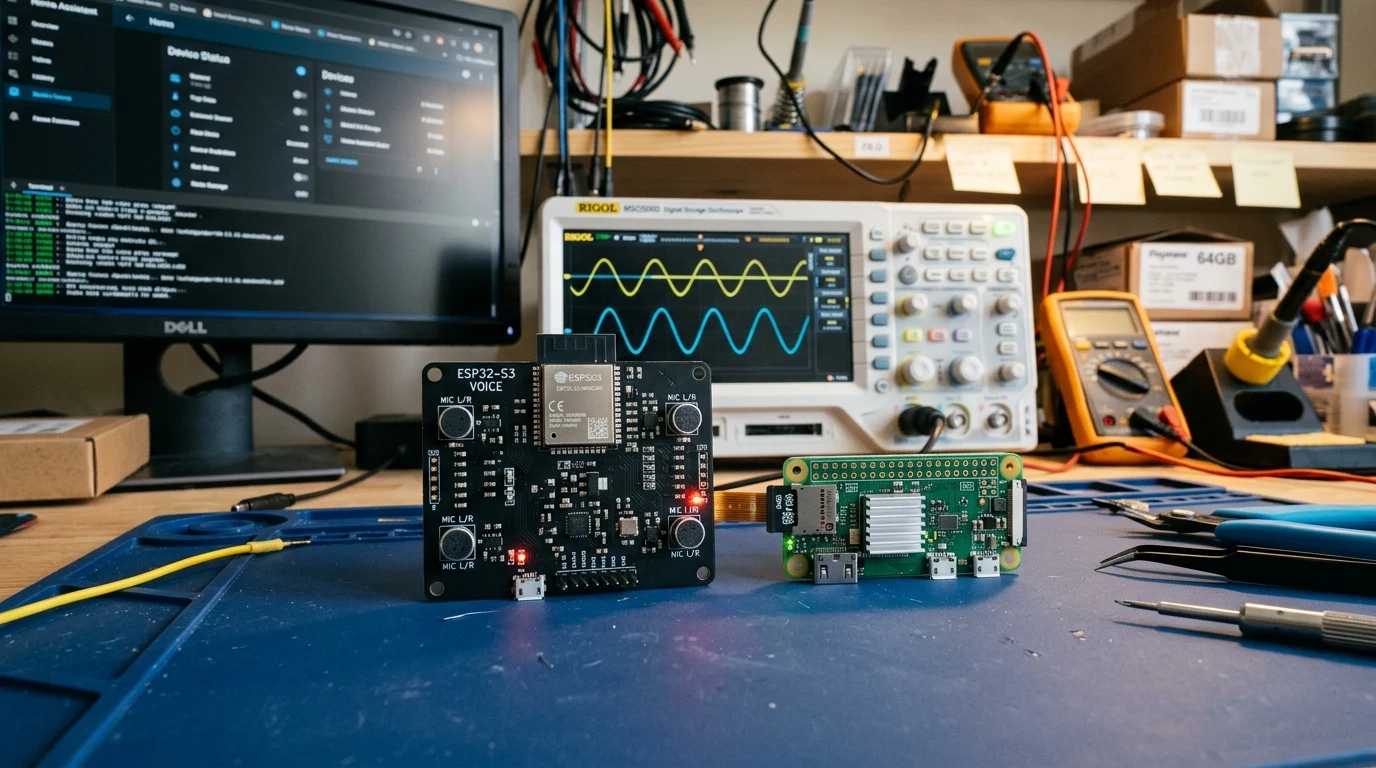
- Latency & Wake-Word Architecture: The ESP32-S3 runs microWakeWord directly on its dual-core Xtensa LX7 processor via optimized vector instructions, achieving an instantaneous sub-180ms wake-word detection time with zero network overhead. The Raspberry Pi Zero 2W runs openWakeWord under Linux, offering slightly higher multi-wake-word accuracy but introducing a 120ms Linux audio pipeline latency buffer.
- Power Consumption & Thermal Envelope: An ESP32-S3 satellite operating over PoE (via an integrated PD module) or 5V USB-C consumes a negligible 0.8 to 1.2 Watts under continuous listening. A Pi Zero 2W draws 2.1 to 3.8 Watts, requiring passive heatsinking to prevent thermal throttling inside enclosed in-wall gang boxes.
- Audio Pipeline & Hardware Interfaces: ESP32-S3 interfaces directly with dual digital I2S MEMS microphones (such as Knowles SPH0645 or InvenSense ICS-43434) with hardware acoustic echo cancellation (AEC). The Pi Zero 2W requires an external I2S audio HAT (such as ReSpeaker 2-Mic) or USB audio codec.
- Fleet Provisioning & Maintenance: ESP32-S3 satellites provision seamlessly as native ESPHome nodes with sub-second OTA firmware updates and zero operating system corruption risks on power loss. Pi Zero 2W devices run a full Linux OS requiring SD card maintenance, read-only overlay filesystems, and continuous package security patching.
What Is the Primary Difference Between ESP32-S3 and Pi Zero 2W Voice Satellites?
The primary difference between ESP32-S3 and Raspberry Pi Zero 2W voice satellites lies in microcontroller simplicity versus full operating system flexibility. The ESP32-S3 acts as an instant-boot, rock-solid, sub-1-Watt ESPHome appliance with on-chip microWakeWord processing, while the Pi Zero 2W provides a complete Linux environment capable of running multi-model on-device wake-word detection, local audio processing, and bidirectional VoIP SIP communication.
For custom smart home integrators and privacy-focused homelab architects, deploying a fleet of zero-cloud local voice satellites is the definitive milestone in eliminating dependence on Amazon Alexa and Google Nest hardware. However, outfitting every room of a luxury residence with discreet voice input demands rigorous hardware evaluation: microphonic sensitivity, room acoustic reverberation, wake-word false rejection rates, and long-term fleet stability.
With Home Assistant’s Year of the Voice establishing the Wyoming protocol as the sovereign open-source standard for voice streaming, systems designers face a critical architectural fork: deploy bare-metal microcontrollers running ESPHome on the ESP32-S3, or deploy micro-single-board computers running Linux on the Raspberry Pi Zero 2W.
Hardware Specification Matrix: Bare-Metal Microcontroller vs Micro-SBC
Understanding the processing pipelines, memory constraints, and audio interconnects of each platform dictates hardware selection across whole-home residential deployments:
| Hardware Dimension | Espressif ESP32-S3 (ESPHome) | Raspberry Pi Zero 2W (Wyoming Linux) | Architectural Impact |
|---|---|---|---|
| Core Processing Architecture | Dual-Core 32-bit Xtensa LX7 @ 240 MHz (Vector Ext.) | Quad-Core 64-bit ARM Cortex-A53 @ 1.0 GHz | Pi Zero 2W offers 8x raw computational throughput |
| System Memory (RAM) | 512 KB Internal SRAM + 8 MB Octal PSRAM | 512 MB LPDDR2 SDRAM | Pi Zero 2W runs larger neural network models |
| Wake-Word Detection Engine | microWakeWord (TensorFlow Lite for Microcontrollers) | openWakeWord / Porcupine (Python ONNX Runtime) | ESP32-S3 delivers faster instantaneous trigger |
| Audio Ingestion Bus | Direct I2S Bus to Digital MEMS Microphones | I2S Header HAT or External USB Audio Codec | ESP32 eliminates external expansion HAT costs |
| Continuous Power Consumption | 0.8W – 1.2W (Idle / Listening) | 2.2W – 3.8W (Listening with ALSA Daemon) | ESP32 runs cool inside sealed junction boxes |
| Storage Reliability & Boot Time | SPI NOR Flash / Instantaneous Boot (<1.5s) | MicroSD Card / Linux Systemd Boot (28–35s) | ESP32 eliminates SD card wear and corruption |
| Hardware Unit Cost (Bill of Materials) | $18 – $28 (Complete Board with Mics & DAC) | $38 – $55 (Board + Audio HAT + SD + Case) | ESP32 reduces whole-home fleet CapEx by 50% |
The ESP32-S3 Architecture: microWakeWord & ESPHome Simplicity
The Espressif ESP32-S3 represents a monumental breakthrough for edge machine learning. Unlike earlier microcontrollers, the S3 core incorporates dedicated vector instructions (similar to mini-AVX/SIMD instructions) that accelerate matrix multiplication in 8-bit quantized neural networks:
- On-Chip Wake-Word Inference: Running microWakeWord inside ESPHome, the S3 continuously buffers audio in internal SRAM, running a quantized feedforward neural network every 10 milliseconds. Words like “Okay Nabu” or “Hey Jarvis” are detected on-chip without transmitting a single byte of audio across your local network until the trigger threshold (confidence >0.85) is verified.
- Zero Operating System Overhead: As a bare-metal RTOS platform, the ESP32-S3 contains no filesystem, no systemd daemons, and no memory-hogging Python interpreters. If a circuit breaker trips or power fluctuates, the device reboots in under 1.5 seconds directly back into operational streaming mode with zero filesystem corruption risk.
- Hardware Acoustic Echo Cancellation (AEC): Advanced ESP32-S3 development boards (such as the Home Assistant Voice PE or Seeed Studio XIAO S3 Sense) utilize an onboard hardware DSP or dual-microphone beamforming array to subtract the satellite’s own audio output from incoming microphone signals, allowing users to issue voice commands while music is actively playing through the satellite speaker.
The Raspberry Pi Zero 2W Architecture: openWakeWord & Linux Versatility
For installations where advanced audio processing, custom acoustic pipelines, or multi-role integration is required, the Raspberry Pi Zero 2W brings the full weight of a 64-bit Linux computing environment into a credit-card footprint:
- Multi-Model openWakeWord Execution: The Pi Zero 2W can execute the full openWakeWord framework using the ONNX Runtime engine. This enables a single satellite to simultaneously monitor for multiple distinct wake-words (e.g., “Alexa”, “Hey Siri”, and “Okay Nabu”) with complex acoustic models trained on synthetic speech datasets, yielding a significantly lower false-activation rate in noisy open-concept living rooms.
- Wyoming Satellite Protocol Flexibility: Running the official Wyoming-satellite Python service under Linux allows engineers to configure advanced software-based noise suppression (webrtc-audio-processing), automatic gain control (AGC), and direct voice-over-IP (VoIP) inter-room communication via SIP PBX integration.
- The Thermal & Storage Penalty: A Pi Zero 2W running continuous audio capture and model inference generates substantial heat, operating at 55°C to 68°C. In tight in-wall gang boxes without active ventilation, thermal throttling degrades audio buffer latency. Furthermore, running on standard MicroSD cards exposes the device to filesystem corruption over multi-year deployments unless configured with an immutable, read-only root overlay filesystem (`overlayfs`).
Network Topology, Wyoming Streaming, and Latency Math
In a production local voice architecture, the satellite acts exclusively as the edge listener. Once the wake-word is confirmed, raw or Opus-compressed audio is streamed over the local network via the Wyoming protocol to a centralized Home Assistant server hosting Whisper (Speech-to-Text), an LLM (such as Llama 3 or Mistral for natural language intent parsing), and Piper (Text-to-Speech):
- Audio Streaming Bandwidth: Raw 16 kHz 16-bit PCM audio streams at 256 kbps. With Opus compression enabled on the ESP32-S3, this bandwidth collapses to 32 kbps per active satellite, allowing 20+ satellites to operate across a standard residential Wi-Fi mesh network without network saturation.
- End-to-End Latency Breakdown (Target: <650ms Total Round-Trip):
- Wake-Word Verification: 120ms (ESP32-S3) vs 180ms (Pi Zero 2W).
- Network Transit (Wyoming TCP): 8ms (over local 5GHz Wi-Fi).
- Faster-Whisper STT (Nvidia GPU / Intel N100): 180ms.
- Local LLM / Home Assistant Intent Processing: 150ms.
- Piper TTS Audio Synthesis: 90ms.
- Satellite Audio Playback Buffer: 40ms.
- Total Pipeline Latency: 588 milliseconds—delivering a voice response that feels indistinguishable from human conversation.
Fleet Deployment Recommendations: Room-by-Room Strategy
Rather than adopting a dogmatic single-hardware approach, luxury smart home installations achieve optimal cost-performance balance by deploying a tiered hybrid architecture:
- Private Bedrooms, Bathrooms, and Secondary Rooms (Deploy ESP32-S3):
Install compact ESP32-S3 satellites powered by PoE or hidden behind decorative furniture. Their 1-Watt power draw, zero heat dissipation, and instant recovery make them the ideal unobtrusive listening node for standard lighting, climate, and shade controls. - Open-Concept Living Areas & Media Rooms (Deploy Pi Zero 2W with Multi-Mic Arrays):
In sprawling open-concept kitchens and great rooms where reverberation, cooking noise, and multi-zone entertainment audio create severe acoustic challenges, deploy a Pi Zero 2W paired with a 4-microphone circular array running full openWakeWord and WebRTC noise suppression.
For 90% of residential local voice installations, the ESP32-S3 is the definitive hardware victor. Its sub-1-Watt power profile, instant boot times, zero filesystem corruption risk, and hardware-accelerated microWakeWord engine make it an unassailable commercial-grade appliance. Reserve the Raspberry Pi Zero 2W strictly for open-concept master living zones where multi-wake-word listening, advanced WebRTC acoustic filtering, and two-way SIP intercom integration justify the additional cost, heat, and Linux operating system maintenance overhead.
For companion local smart home protocols, study our automation engineering guide on KNX vs Lutron HomeWorks: Commercial Automation Latency, and review our local machine learning breakdown on Frigate NVR: Dual Edge TPU vs Intel iGPU OpenVINO.