⚡ Executive Acoustic Blueprint: Room Correction Mechanics
- The Room Transfer Function: In an untreated residential room, standing boundary waves introduce +12dB to -18dB frequency peaks and nulls below 200 Hz.
- Phase & Time Domain Correction: Mixed-phase filtering vs. IIR minimum-phase EQ. Dirac Live corrects the impulse response (decay time) across the entire acoustic envelope.
- Subwoofer Integration: Dirac Live Bass Control (DLBC) utilizes AI co-optimization to calculate phase-aligned crossover points across multiple subwoofers.
- Processing Overhead: Dedicated DSP processing on modern AV processors (Denon, Marantz, StormAudio, Monolith).
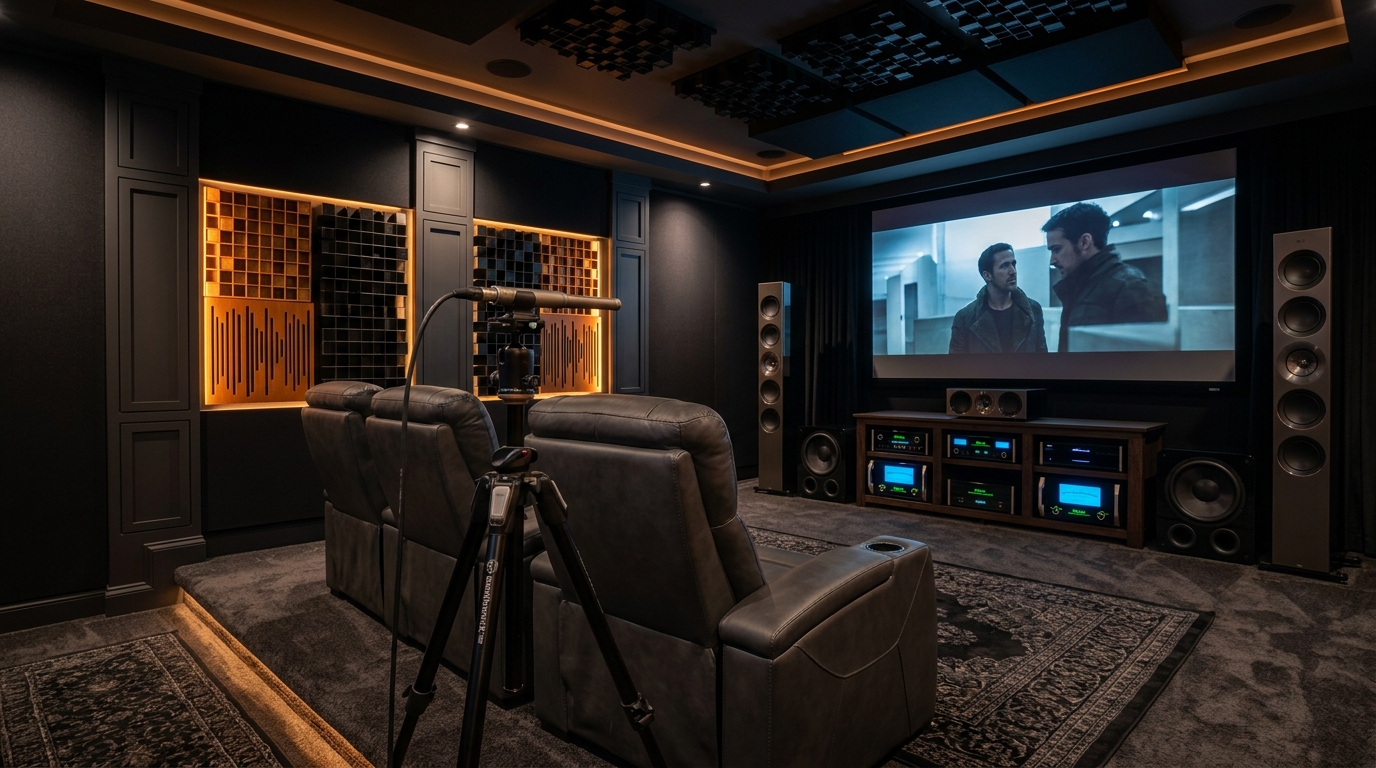
In high-end architectural audio and custom home theater design, a fundamental acoustic truth is often overlooked by consumers: the room itself contributes more than 50% of the acoustic sound signature reaching your ears. You can spend $15,000 on audiophile floorstanding speakers and dual 15-inch subwoofers, but when placed inside a standard rectangular living room with drywall and hardwood floors, physics takes over.
Standing waves create boomy 45 Hz resonance peaks that drown out dialogue, while destructive phase cancellation creates massive “bass nulls” at the primary listening position where low frequencies completely vanish. In 2026, modern digital signal processing (DSP) room correction platforms—led by Dirac Live and Audyssey MultEQ-X—have transformed from basic graphic equalizers into mathematical acoustic engines.
1. Impulse Response: Frequency Domain vs. Time Domain Correction
Traditional equalizers (and legacy auto-calibration systems) only correct magnitude in the frequency domain. If a microphone detects a +8dB peak at 60 Hz, an IIR filter cuts the volume at 60 Hz. However, sound is a dynamic time-domain wave. Energy bouncing off side walls and ceilings arrives at your ears delayed by several milliseconds, smearing transients and destroying imaging clarity.
Dirac Live utilizes patented mixed-phase filtering that operates simultaneously in the frequency domain and the time domain (impulse response):
| Acoustic Metric | Audyssey MultEQ-X ($199 PC License) | Dirac Live with Bass Control ($799 Tier) |
|---|---|---|
| Correction Architecture | IIR Parametric & FIR Target Curve EQ | Mixed-Phase Impulse Response & Magnitude |
| Multi-Subwoofer Handling | Independent level/delay (SubEQ HT) | Co-optimized phase alignment across whole room |
| Measurement Hardware | Audyssey ACM1-X Calibrated Mic | UMIK-1 / UMIK-2 Calibrated USB Mic |
| Soundstage Imaging Precision | Very Good (Clean tonal balance) | Exceptional (Laser-focused phantom center) |
| Platform Compatibility | Denon / Marantz AV Receivers only | StormAudio, Monolith, Denon, Marantz, Onkyo, miniDSP |
By correcting the arrival times of early reflections, Dirac eliminates the phase smearing that makes high-end speakers sound muddy. Vocals snap to the center of the acoustic soundstage as though a physical phantom speaker were floating in mid-air.
2. Multi-Sub Bass Control (DLBC): Eliminating Room Modes
When running two or four subwoofers in a home theater, traditional calibration tools adjust the distance (delay) and volume (trim) of each sub independently. However, once both subwoofers play simultaneously, their soundwaves collide in the room, creating new phase cancellations.
Dirac Live Bass Control (DLBC) solves this through mathematical co-optimization. Instead of calibrating each subwoofer in isolation, the DLBC algorithm calculates how the subwoofers and main speakers interact as a unified acoustic array, continuously adjusting all-pass phase filters to ensure bass remains tactile, punchy, and identical across every seat in the room.
To control high-end media playback seamlessly without proprietary cloud apps, pair your AV processor with our blueprint for building a zero-cloud smart home with local voice AI and Home Assistant.
3. Clean Power Infrastructure for High-Current Amplification
Driving 9 to 13 channels of audio alongside multiple high-excursion subwoofers places immense transient current demands on your home’s electrical panel. When an action film triggers a sudden 20 Hz explosion, high-current toroidal amplifiers pull sudden 15A–20A spikes from the wall.
To prevent nuisance breaker trips and protect sensitive DAC circuitry from electrical noise, wire your AV rack through dedicated circuits managed by smart electrical breaker panels like SPAN and Schneider Square D with continuous power conditioning.
Chief Systems Analyst’s Verdict
If you own a Denon or Marantz receiver and want granular target curve adjustment on a budget, Audyssey MultEQ-X ($199) is an extraordinary upgrade over standard on-screen setup. However, for uncompromising home theaters featuring multiple subwoofers, Dirac Live with Bass Control remains the undisputed gold standard in 2026 for impulse response clarity and seat-to-seat bass uniformity.
People Also Ask (PAA)
Is Dirac Live worth the upgrade over standard receiver room correction?
Yes. Dirac Live corrects both frequency response and impulse response (time-domain reflections), resulting in significantly clearer dialogue, tighter bass transients, and a broader acoustic soundstage compared to basic receiver equalizers.
What microphone should I use for Dirac Live calibration?
A calibrated USB measurement microphone such as the miniDSP UMIK-1 or UMIK-2 is recommended. Each microphone includes a unique 90-degree and 0-degree calibration file to guarantee measurement accuracy.
Does Dirac Live replace physical acoustic room treatments?
No. Digital room correction complements physical acoustic treatments. Bass traps and first-reflection absorption panels eliminate physical flutter echoes and room decay, allowing Dirac Live’s DSP filters to operate with minimal phase strain.