
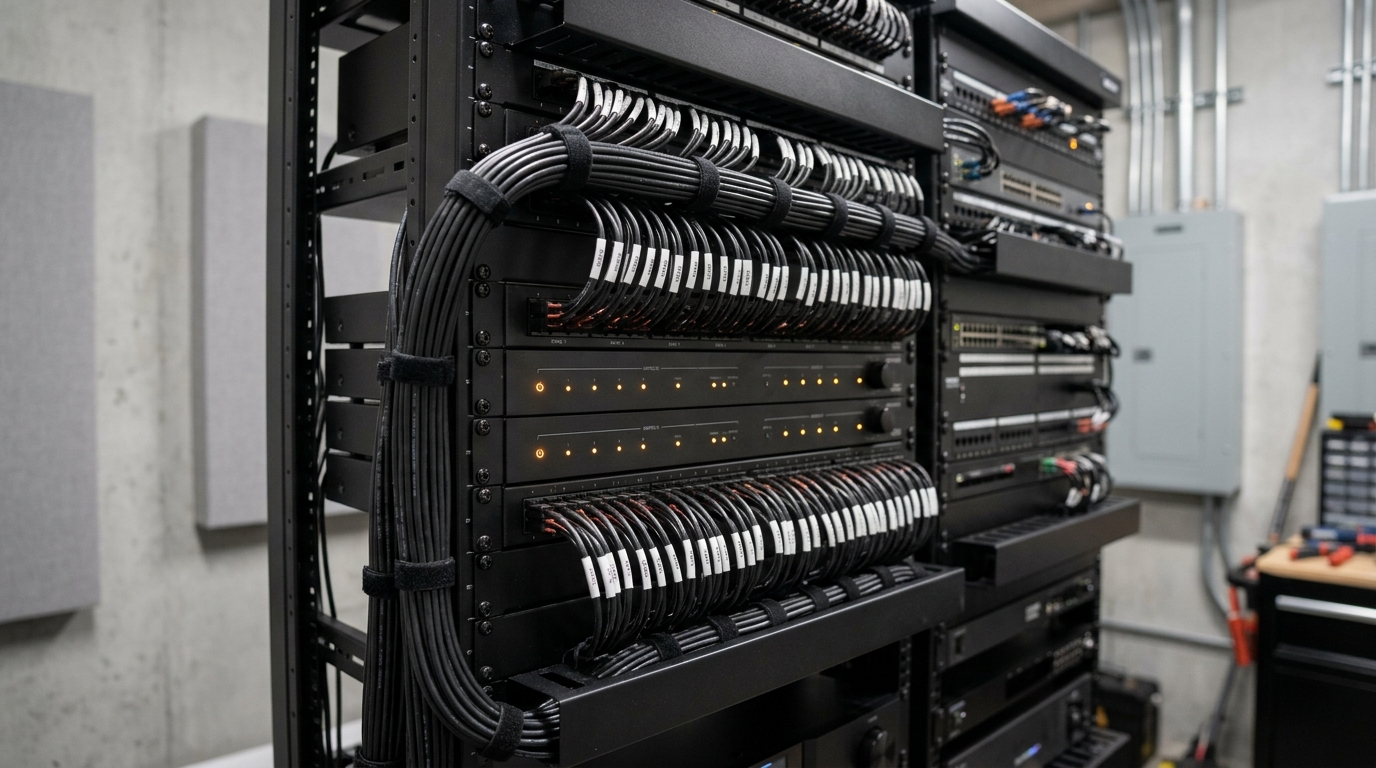
- Centralized Infrastructure: Replaces distributed wireless tabletop speakers and modular wall-wart units with a centralized 19-inch equipment rack housing 8- to 16-channel Class-D matrix amplifiers (e.g., AudioControl Director, Anthem MDX, Crestron NAX), feeding architectural in-ceiling and in-wall speakers over 14/2 and 14/4 OFC copper.
- Hardware DSP & Parametric Acoustic Tuning: Dedicated matrix amplifiers provide per-zone 10-band parametric equalizers, high/low-pass crossover filters, and boundary compensation filters, correcting for ceiling cavity resonance and open-concept architectural flutter echoes.
- Deterministic Latency & IP Control: Native integration with Control4, Crestron Home, Savant, and Home Assistant via deterministic TCP/IP or RS-232 protocols. Zero Wi-Fi mesh broadcast storms, zero spontaneous multi-room audio sync drift, and zero consumer app deprecation cycles.
- Network Audio Integration: Complements high-density network backbones outlined in our residential structured cabling and 10GbE fiber architecture and links seamlessly with Dante AoIP & AES67 multi-zone residential audio distribution.
In modern luxury residential architecture, multi-room audio is an essential lifestyle expectation. Homeowners want high-fidelity sound in the kitchen, outdoor patio, master suite, private wellness spa, and entertainment pavilions. However, an architectural chasm divides how high-performance audio is implemented: the consumer wireless plug-and-play model epitomized by Sonos / Bluesound versus the professional custom-installation paradigm of centralized multi-zone matrix amplifiers.
While consumer wireless systems offer effortless setup for modest apartments or single-family renovations, scaling consumer gear across 12, 16, or 24 independent audio zones in an expansive estate exposes deep engineering flaws. From Wi-Fi spectrum congestion and multicast flooding to rigid consumer software updates and lack of room-specific acoustic DSP, consumer wireless ecosystems quickly buckle. Below, we conduct a forensic teardown of centralized audio matrix architecture, examining thermal load management, DSP acoustic optimization, IP control determinism, and long-term asset value.
1. Engineering Teardown: Centralized Matrix Architecture vs. Wireless Sonos
To understand why custom integration firms avoid stacking dozens of consumer wireless amps in an estate, we must analyze the hardware and network topologies side-by-side:
| Architecture Dimension | Centralized Matrix Amplifiers (AudioControl / Anthem MDX) | Modular Wireless System (Sonos Amp / Port Stack) | Forensic Analysis & Impact |
|---|---|---|---|
| Form Factor & Density | 1U to 2U Rackmount Enclosure (8 to 16 amplified channels per chassis) | Individual modular bricks (requires third-party shelves, zip-ties, separate power bricks) | A 16-zone system requires 3U of rack space for matrix amps vs. 12U+ of messy, unventilated Sonos shelves. |
| DSP & Room Correction | Per-channel 10-band Parametric EQ, High/Low Pass Crossovers, Subwoofer Phase Alignment, Anthem ARC Genesis | Basic Treble/Bass sliders; Trueplay (limited, iOS microphone only, locked to Sonos hardware) | Trueplay cannot correct architectural ceiling cavity nulls, boundary loading, or integrate 3rd-party subwoofers cleanly. |
| Network Audio Distribution | Hardwired Gigabit Ethernet, uncompressed Dante/AES67 or analog busing | Wi-Fi Mesh (SonosNet) or hardwired spanning-tree (STP) Ethernet | Hardwiring 16+ Sonos devices frequently causes Spanning Tree Protocol (STP) network loops and broadcast storms on managed UniFi/Cisco switches. |
| Power & Impedance Handling | Stable down to 2 Ohms; Bridgeable outputs (up to 400W RMS per channel into 8Ω) | 125W into 8 Ohms; unstable below 4 Ohms; non-bridgeable | Matrix amps can drive power-hungry outdoor landscape subwoofers and parallel ceiling pairs without thermal shutdown. |
| Control Integration | Deterministic two-way IP/RS-232 control API (Crestron, Control4, Savant, Home Assistant) | Cloud-dependent API / UPnP (subject to sudden corporate API revisions and cloud service outages) | Matrix amps respond in under 5ms to wall keypad or automation commands; zero cloud dependency. |
| Thermal Reliability | High-efficiency Class D with internal active cooling tunnels and thermal circuit telemetry | Passive chassis dissipation; extreme heat concentration when racked side-by-side | Dense Sonos racks generate massive hotspots, degrading capacitors and triggering thermal throttling. |
2. The Network Nightmare: Spanning Tree Protocol (STP) & Multicast Flooding
In single-family homes with 2 or 3 wireless speakers, Sonos functions smoothly over Wi-Fi. However, when an estate installs 12 to 24 Sonos Amps in a central AV rack and plugs Ethernet cables into an enterprise managed network (Ubiquiti UniFi, Cisco Catalyst, or Aruba Instant On), a catastrophic network breakdown frequently occurs.
Sonos devices utilize a legacy proprietary mesh networking protocol known as SonosNet, which relies on Spanning Tree Protocol (802.1D STP) to prevent network loops. Modern enterprise network switches default to Rapid Spanning Tree Protocol (802.1w RSTP) or Multiple Spanning Tree (MSTP) with path cost values designed for 10GbE/1GbE fiber backbones.
- If a Sonos Amp has both Wi-Fi enabled and an Ethernet cable connected, it attempts to bridge the wired and wireless networks using 802.1D BPDUs (Bridge Protocol Data Units).
- The enterprise switch detects the 802.1D BPDU, flags a spanning-tree topology change, and places core switch ports into discarding/blocking states to prevent loops.
- Entire VLANs lose internet connectivity, security cameras disconnect, and touch panels freeze—all triggered by consumer audio units warring with enterprise network switches.
- Centralized matrix amplifiers avoid this entirely: each amplifier is a simple, deterministic IP endpoint that does not broadcast mesh beacons or establish rogue wireless bridges.
3. Parametric DSP, Room Correction & Architectural Acoustic Realities
Architectural in-ceiling speakers face brutal acoustic physics. Unlike freestanding hi-fi speakers housed in rigid, damped, engineered cabinets, architectural speakers are clamped into flexible 1/2-inch drywall. The back of the speaker driver fires directly into an uncalibrated ceiling joist cavity, creating unpredictable acoustic resonances between 100Hz and 300Hz.
Furthermore, open-concept luxury spaces feature hard reflective surfaces: polished hardwood, floor-to-ceiling glass windows, quartz kitchen islands, and tile floors. Consumer treble/bass tone controls cannot resolve these issues. Centralized matrix amplifiers (such as the Anthem MDX-16 or AudioControl Director M6800) provide professional DSP suites:
- Anthem Room Correction (ARC Genesis): Uses a calibrated USB microphone to sweep every room independently, calculating target frequency response curves, phase alignment, and room boundary filters for up to 16 discrete zones.
- High-Pass & Low-Pass Bass Management: Allows custom integrators to add discrete architectural in-wall or in-floor subwoofers to any zone, crossing over ceiling speakers at 80Hz while directing deep bass (20Hz–80Hz) to a dedicated high-current subwoofer amplifier channel.
- Speaker Profile Presets: Preloaded FIR/IIR DSP curves engineered specifically for premium architectural speaker lines (Sonance Architectural, Bowers & Wilkins, James Loudspeaker, Revel Architectural), ensuring linear phase response and optimal driver protection.
4. The Hybrid Compromise: Using Sonos Ports as Matrix Inputs
For homeowners who adore the familiar Sonos mobile app interface or Spotify Connect ecosystem, custom systems architects do not need to choose between poor amplification and complex interfaces. The industry gold standard for luxury residential design is the Hybrid Architecture:
Install a bank of 3 to 6 Sonos Port or Bluesound NODE network streamers mounted cleanly in a 1U rack shelf with Wi-Fi permanently disabled. Route their coaxial digital or analog outputs directly into the audio matrix switcher / matrix amplifier. The family uses the native Sonos app to stream audio, but the distribution, DSP room correction, high-current amplification, and speaker wiring are handled by rock-solid commercial matrix hardware.
This hybrid approach isolates consumer software updates from the hardware amplification layer. If Sonos pushes a disruptive software revision, the physical infrastructure of the estate remains completely unaffected and ready for future streamer upgrades.
5. Frequently Asked Questions (PAA Protocol)
Why do custom AV integrators prefer 14/2 and 14/4 speaker wire over wireless?
Copper in-wall cabling is immune to RF interference, Wi-Fi channel crowding, microwave radiation, and bandwidth congestion. An uncompressed analog audio signal running through 14AWG oxygen-free copper (OFC) delivers zero latency, infinite reliability, and will last 50+ years without requiring firmware updates or hardware obsolescence.
Can centralized matrix amplifiers be controlled through Home Assistant?
Yes. Leading architectural matrix amplifiers (AudioControl, Anthem MDX, Monoprice 6-Zone, VSSL) offer documented local TCP/IP, REST, or RS-232 serial control APIs. Home Assistant features native integrations for these matrix amps, allowing automated input switching, volume limits, and zone grouping directly from local smart home dashboards and wall keypads without internet access.
What is the total cost difference between an 8-zone Sonos Amp setup vs. an 8-zone matrix amplifier?
An 8-zone Sonos Amp system requires 8 units at ~$700 each ($5,600 hardware) plus rack shelves and power distribution. A commercial 16-channel / 8-zone matrix amplifier with advanced DSP (such as an Anthem MDX-16 or AudioControl Director) ranges from $4,500 to $6,000. While equipment costs are virtually identical, the matrix amplifier delivers vastly superior rack density, individual parametric EQ, robust 2-ohm stability, and true enterprise network reliability.
In high-end architectural estates, treating whole-home audio as a consumer wireless accessory is a fundamental design mistake. Centralized matrix amplifiers provide the thermal durability, high-current drive capability, parametric DSP room correction, and deterministic network stability required for multi-zone excellence. For clients demanding consumer streaming convenience, pair rack-mounted streamers with professional matrix amps to achieve the perfect balance of intuitive control and reference acoustic performance.