
The Physics of RF Propagation: Sub-GHz vs. 2.4 GHz Bandwidth
Modern luxury homes are hostile radio environments. Structural steel beams, hydronic radiant floor heating grids, spray-foam insulation with foil vapor barriers, and architectural concrete act as literal Faraday cages. Thread operates in the globally unlicensed 2.4 GHz ISM band—the exact same spectrum overcrowded by high-throughput Wi-Fi 6E/7, Bluetooth LE, baby monitors, and microwave RF bleed.
Z-Wave Long Range operates strictly in the sub-GHz spectrum (908.4 MHz / 916 MHz in North America). The fundamental physics of radio wavelength dictate that lower frequencies bend around physical obstructions and penetrate dense building materials with exponentially less signal attenuation than 2.4 GHz waves.
For more on integrating local control protocols without proprietary cloud latency, review our architectural teardowns on Matter-over-Thread mesh reliability and border routers and building a zero-cloud smart home with Home Assistant.
Forensic Protocol Comparison: Z-Wave Long Range vs. Matter-over-Thread
| Specification Metric | Z-Wave Long Range (ZWLR) | Matter-over-Thread (802.15.4) |
|---|---|---|
| RF Operating Frequency | 912 – 920 MHz (Sub-GHz) | 2.4 GHz (High Congestion) |
| Network Topology | Star Topology (Direct to Hub, 0 hops) | Self-Healing Mesh (Multi-hop routing) |
| Maximum Outdoor Range | Up to 1.0 Mile (1.6 km) line-of-sight | 100 – 150 ft per hop |
| Maximum Nodes per Network | 4,000 devices (Unified estate ID) | ~250 – 500 practical nodes |
| Obstacle Penetration | Porous stone, concrete walls, soil/gates | Drywall, timber framing |
| Battery Coin-Cell Lifespan | Up to 10 years (Adaptive power control) | 1.5 – 3 years (Sleepy End Devices) |
4 Architectural Directives for Estate Automation
1. Deploy ZWLR for Perimeter & Deep Infrastructure
Never rely on 2.4 GHz Thread mesh routing to reach a motorized driveway gate, remote pool house pump controller, or mailbox sensor 400 feet from the main residence. ZWLR’s +30 dBm transmit power and direct star communication penetrate exterior brick veneers and reach the property line with zero repeater repeat nodes.
2. Reserve Matter-over-Thread for Interior End-Point Density
Inside the conditioned envelope of the home, Matter-over-Thread excels at smart plugs, smart shades, and in-wall light switches where mains-powered devices act as router nodes. With IPv6 addressing, Thread integrates cleanly into local VLANs without proprietary protocol translation.
3. The Dynamic Transmit Power Algorithm
ZWLR incorporates automated dynamic power regulation. If a door lock is located 12 feet from the coordinator, the radio reduces output power to conserve coin-cell battery life. When transmitting to a detached carriage house, the radio automatically scales to maximum output power in real time.
4. Structured Cabling and Dedicated PoE Gateways
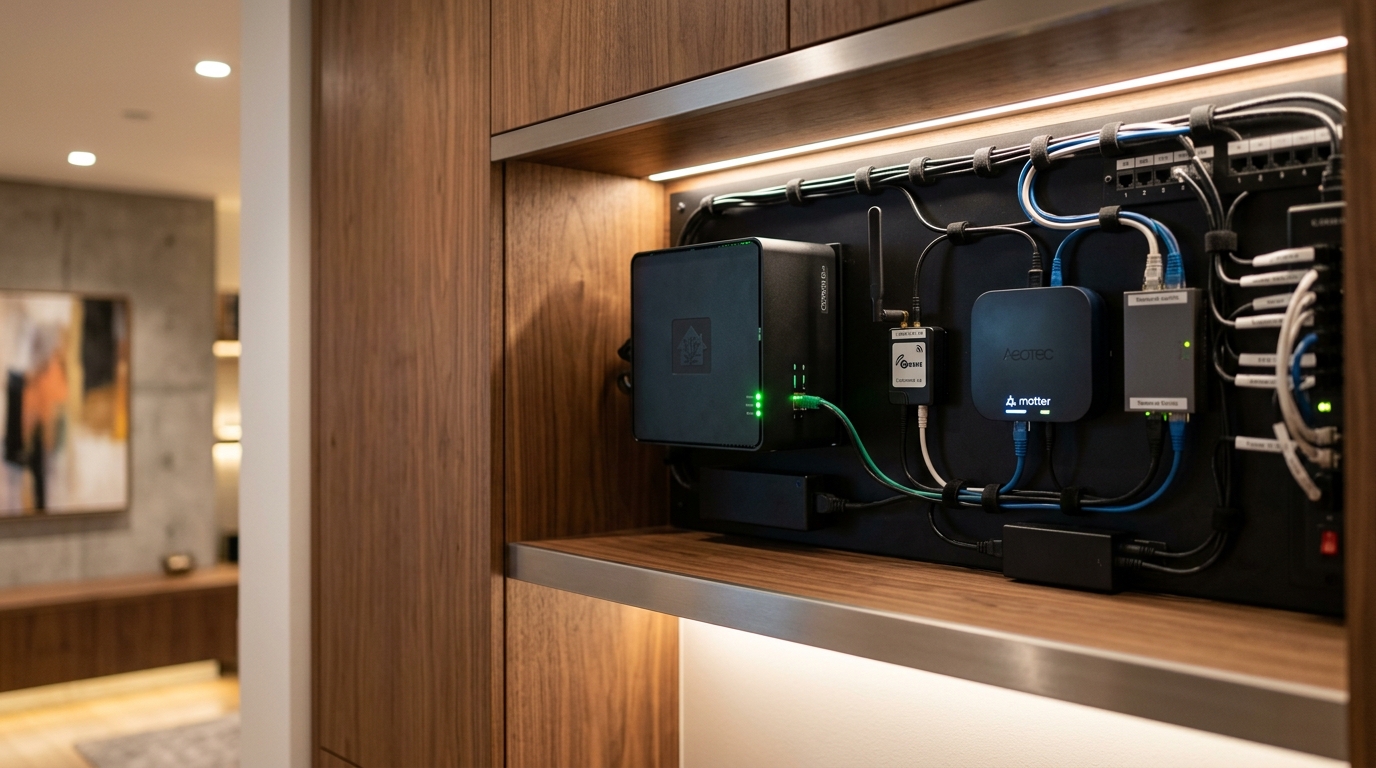
Avoid cheap USB dongles plugged directly into server chassis ports. USB 3.0 ports emit massive broadband RF noise that deafens 2.4 GHz and 900 MHz receivers. Mount dedicated PoE gateways (like the TubesZB or Zooz 800 Z-Wave controller) high on structured central walls connected via shielded Cat6A cabling.
To ensure your network backbone can sustain this infrastructure, see our technical reference on residential 10GbE fiber and Cat6A structured cabling.