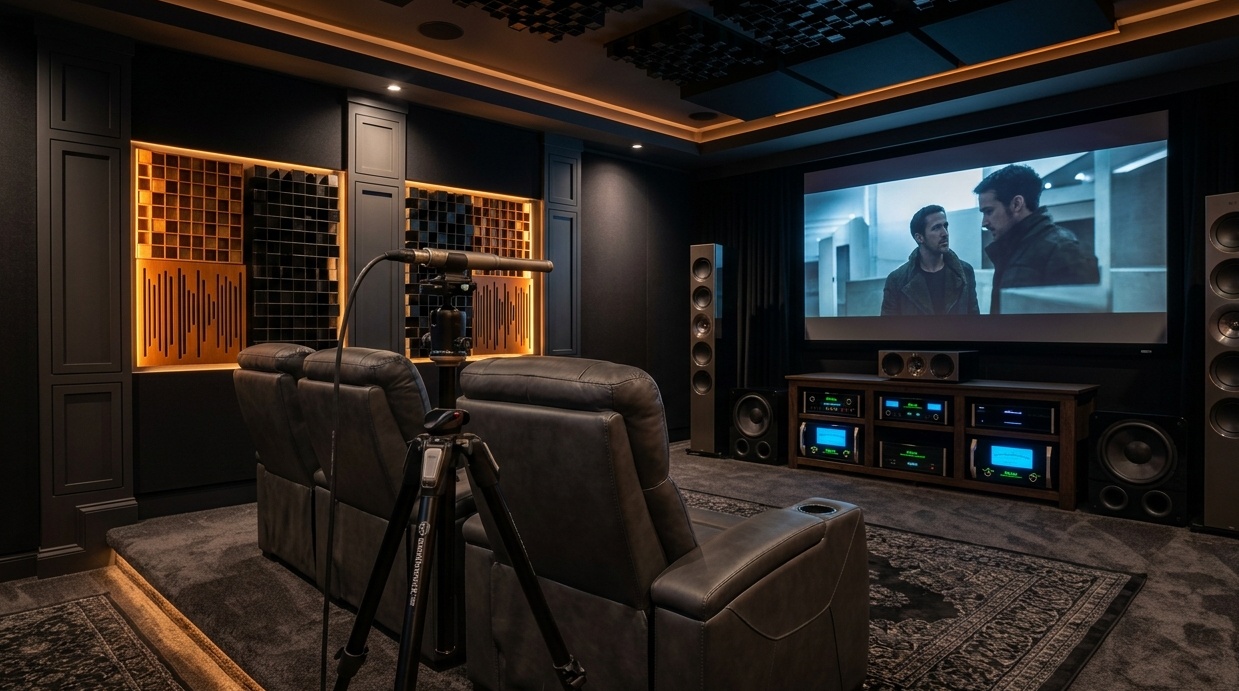
- The Spatial Bass Problem: Room modes create standing wave peaks (+12dB) and destructive nulls (-20dB) below 100Hz. While adding dual or quad subwoofers smooths frequency response across seating rows, manually aligning phase, delay, and crossovers is mathematically intractable.
- Dirac Live Bass Control (DLBC): Co-optimizes all subwoofers simultaneously with the main speaker crossovers using complex all-pass filters, aligning impulse responses and eliminating destructive crossover cancellation in under 20 minutes directly within your AVR processor.
- Multi-Sub Optimizer (MSO): An open-source algorithmic powerhouse utilizing miniDSP hardware. It calculates parametric EQ, delay, and gain coefficients across multiple listening positions with infinite granular flexibility, but requires hours of manual REW acoustic measurement.
In high-performance residential acoustics and private cinema design, low frequencies (20Hz – 120Hz) represent 80% of perceived acoustic quality and 90% of acoustic calibration headaches. In enclosed rooms, room boundaries cause boundary interference (SBIR) and severe axial, tangential, and oblique room modes, resulting in boomy, sluggish bass in one seat and zero bass impact two seats over.
While deploying multiple subwoofers (typically dual diagonal or four-corner configurations) provides the physical energy distribution necessary to break standing waves, integrating them requires sophisticated DSP. Integrators and audiophiles face a definitive choice: the seamless, automated intelligence of Dirac Live Bass Control (DLBC) or the ultra-granular, hardware-agnostic power of Multi-Sub Optimizer (MSO).
Calibration Matrix: Dirac Live Bass Control vs. Multi-Sub Optimizer
| Acoustic Parameter | Dirac Live Bass Control (DLBC Multi-Sub) | Multi-Sub Optimizer (MSO) + miniDSP |
|---|---|---|
| Hardware Integration Layer | Embedded in AVR/Processor (Denon, Marantz, StormAudio, Monolith). | External DSP hardware: miniDSP 2×4 HD or Flex between AVR & subs. |
| Main Speaker & Sub Crossover Co-Optimization | Native & Automated: Adjusts sub phase specifically to match front L/C/R roll-offs. | Manual: Requires separate measurement sessions with AVR delays locked. |
| Calibration Time Investment | 15 – 30 minutes: Automated 9-to-17 point measurement wizard. | 3 – 6 hours: Measuring each sub independently across 6+ seats in REW. |
| Filter Topology | Mixed-phase, digital all-pass filters & time-domain impulse shaping. | Parametric IIR filters, all-pass delay blocks, gain tapering. |
| Software License Cost | $499 – $799 (Requires base Dirac Live license + DLBC add-on). | $0 (Free open-source software; requires ~$250 miniDSP hardware). |
Why Traditional Auto-EQ Fails with Multiple Subwoofers
Standard AVR calibration algorithms (basic Audyssey or Yamaha YPAO) treat multiple subwoofers as a single mono signal or align their delays independently before summing them. When two subwoofers with identical delays output into an asymmetric room, their sound waves interfere destructively at specific frequencies, creating deep acoustical nulls that no amount of parametric EQ boost can fix without clipping amplifier outputs.
Dirac Live Bass Control addresses this by utilizing all-pass filter phase shifting. Rather than simply delaying Sub 1 or boosting 45Hz on Sub 2, DLBC dynamically alters the phase angle across the frequency spectrum. It forces Sub 2 to actively counteract the acoustic reflections of Sub 1, using the room’s boundary physics to eliminate destructive cancellations.
For a detailed breakdown of Dirac room calibration vs. Audyssey MultEQ-X, see our head-to-head analysis in Dirac Live vs. Audyssey MultEQ-X: Spatial Acoustic Calibration Teardown.
The MSO Workflow: Maximum Granularity for Dedicated Private Theaters
While DLBC is an automated triumph, Multi-Sub Optimizer (MSO) remains the secret weapon of elite acoustic engineers. MSO does not measure audio directly; it is a numerical optimization algorithm that ingests raw acoustic impulse measurement files from Room EQ Wizard (REW).
By measuring each subwoofer individually at each listening seat (e.g., 4 subwoofers measured across 6 seats = 24 individual acoustic sweeps with acoustic timing references), MSO runs a simulated genetic algorithm over millions of permutations. It calculates the exact biquad filters, delay offsets, and gain trims to import into a miniDSP 2×4 HD, achieving a +/- 1.5dB seat-to-seat variation curve across the entire audience row.
If you are also designing whole-home high-resolution audio distribution, explore our teardown on Dante Audio-over-IP vs. AES67 for Luxury Multi-Zone Audio.
Frequently Asked Questions (PAA Direct Answers)
Yes, and this is a popular high-end hybrid strategy. MSO is used across a miniDSP to flatten and time-align all subwoofers into a single virtual “super-subwoofer.” That virtual sub is presented to the AVR as a single input, allowing standard Dirac Live (without DLBC) to calibrate the room and crossover points cleanly without purchasing the expensive DLBC multi-sub license.
Yes. By fixing phase cancellation at the critical 60Hz – 90Hz crossover region between the subwoofers and the front left/center/right speakers, DLBC eliminates the “muddy” smear caused by mismatched group delay, delivering immediate, tight transient bass impact that you can feel in your chest.
If your AV receiver or processor supports it (e.g. Denon X3800H/X4800H, Marantz Cinema series, or StormAudio), Dirac Live Bass Control (Multi-Sub) is worth every penny of its license cost. It automates crossover co-optimization in 20 minutes without external DSP boxes or DAC latency penalties. However, if your AVR lacks DLBC support, or if you are an acoustic perfectionist demanding ultimate mathematical control across 8+ seats, a miniDSP 2×4 HD running Multi-Sub Optimizer delivers reference-grade theater bass for half the financial investment—paid for in your own calibration time.