
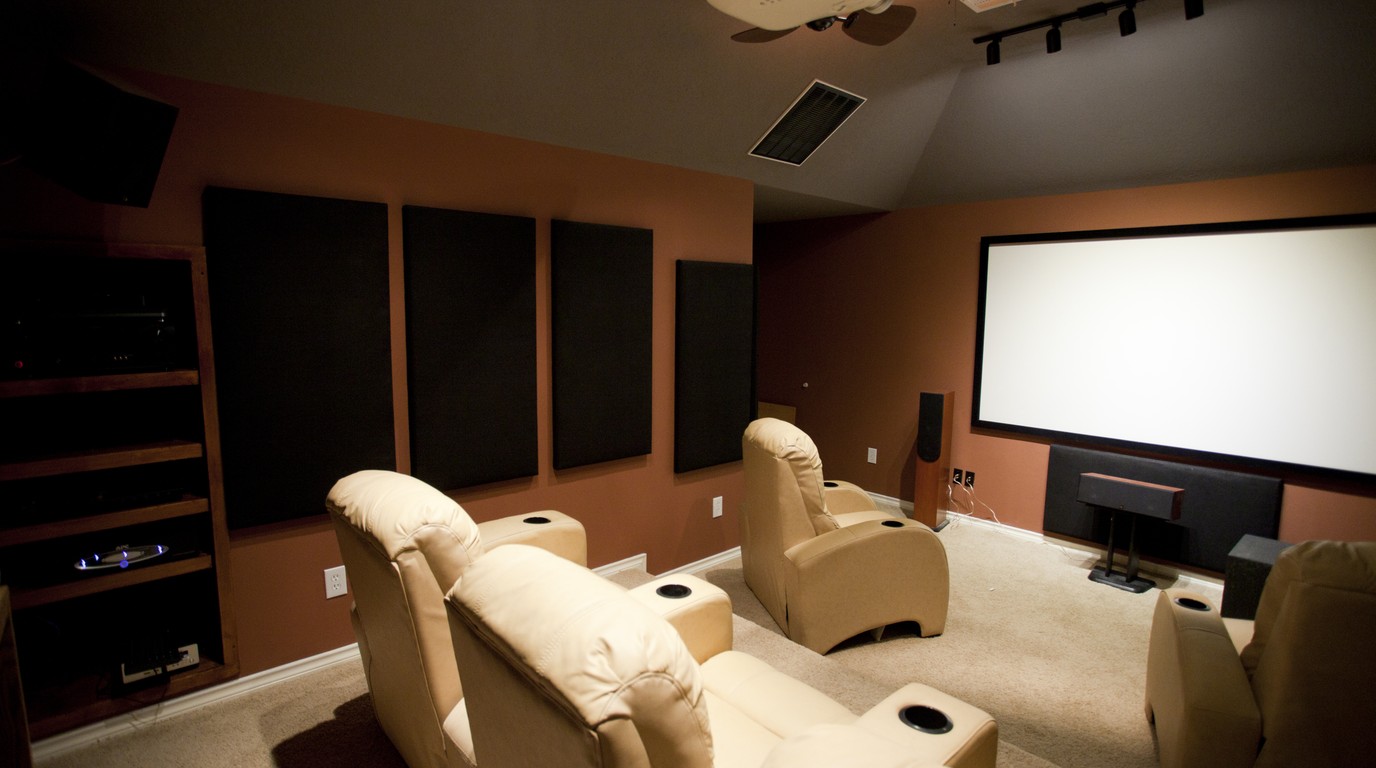
- Active Wave Cancellation: Dirac Live Active Room Treatment (ART) uses non-subwoofer surround and ceiling speakers as active acoustic absorbers, emitting phase-inverted cancellation waves to extinguish room mode reflections before they hit opposite walls.
- Low-Frequency Decay Control: Physical fiberglass bass traps require depths exceeding 24 inches to absorb 30Hz room modes. Both Dirac ART and the Trinnov WaveForming algorithm control RT60 low-frequency decay down to 20Hz digitally, achieving studio-grade 200ms decay times without sacrificing architectural room volume.
- Hardware Ecosystem Access: Trinnov WaveForming strictly requires proprietary Trinnov Altitude16/32 processors ($18k–$35k) and rigid rectangular dual-bass arrays. Dirac ART runs on accessible StormAudio, Denon (AVR-A1H), and Marantz Reference AV10 processors, making active cancellation accessible at one-fourth the entry cost.
In dedicated luxury home cinemas and high-end listening rooms, the most stubborn adversary is not amplifier distortion or speaker frequency response; it is room acoustics. Below 150 Hz—the Schroeder frequency—sound waves behave as modal resonances rather than geometric rays. Standing waves bounce between parallel drywall surfaces, creating devastating constructive peaks (+15dB boomy bass) and destructive nulls (-25dB bass cancellation) that no conventional parametric EQ can correct without destroying amplifier headroom.
Historically, solving room modes required sacrificing significant living space to dense fiberglass bass traps, membrane resonators, and helmholtz absorbers. In 2026, acoustic physics has undergone a digital revolution: Dirac Live Active Room Treatment (ART) and Trinnov WaveForming have pioneered active wave cancellation. By transforming every loudspeaker in the room into an intelligent acoustic sink, these algorithms extinguish bass reflections in real time, delivering tight, tactile, reference-grade low-end transient response.
How Does Active Room Treatment (ART) Use Speakers as Bass Traps?
Dirac Live ART co-optimizes all speakers in the room simultaneously. When a front subwoofer fires a 40Hz bass wave into the room, ART calculates the exact arrival time of that wave at the rear surround speakers and fires an out-of-phase anti-sound wave to cancel the reflection before it bounces back into the listening area.
Traditional room correction systems (such as Audyssey MultEQ-XT32 or basic Dirac Live) treat each loudspeaker as an isolated acoustic channel: the software measures a speaker’s frequency response, applies IIR/FIR filters to flatten the curve, and adjusts millisecond delays. While this improves frequency balance at a single microphone position, it does nothing to control time decay. A 50Hz bass note continues ringing in the room corners for 600ms to 900ms, smearing transient impact and masking subtle midrange dialogue.
Dirac Live ART fundamentally re-imagines acoustic calibration by treating the entire room as a coupled MIMO (Multiple-Input Multiple-Output) system. During calibration, the software maps how sound from every speaker travels to every other speaker location. In playback, when the front subwoofers fire an explosive low-frequency transient, the rear surrounds, side surrounds, and wide channels fire precisely timed negative cancellation impulses. The speakers act as active electronic bass traps, absorbing acoustic energy out of the room rather than allowing it to reflect.
The result is a dramatic reduction in room ringing: low-frequency decay times (RT60) between 20Hz and 100Hz plummet from 750ms down to a tight, studio-mastering standard of 200ms to 250ms. Review our guide to Acoustic Room Treatment, 2D QRD Diffusers and RT60 Decay Calibration for the physical measurement benchmarks.
| Calibration Parameter | Dirac Live Active Room Treatment (ART) | Trinnov WaveForming | Acoustic Engineering Verdict |
|---|---|---|---|
| Hardware Topology | Flexible (Uses existing surround & sub array) | Rigid (Requires front/back planar sub arrays) | Dirac ART adapts to asymmetric real rooms |
| Processor Entry Cost | $6,500 – $15,000 (Marantz AV10 / StormAudio) | $18,000 – $38,000+ (Altitude16 / Altitude32) | Dirac ART delivers 85% of Trinnov for 1/3 cost |
| Cancellation Bandwidth | 20 Hz – 150 Hz (Selectable per speaker group) | 20 Hz – 100 Hz (Dedicated planar wave) | Both eliminate destructive modal nulls |
| Physical Room Traps Required | Minimal (Only high-frequency flutter absorption) | Zero bass traps required on front/rear walls | Reclaims 15% to 20% of room square footage |
Dirac ART vs. Trinnov WaveForming: The Luxury Cinema Shootout
Trinnov WaveForming generates a pure plane wave from a front subwoofer grid and actively absorbs it at an identical rear subwoofer grid, delivering near-flawless modal eradication in purpose-built rectangular rooms. Dirac Live ART is far more practical for real-world luxury homes, utilizing existing surround and ceiling speakers to cancel reflections in non-symmetrical spaces.
While Trinnov’s WaveForming is an acoustic tour-de-force, its physical constraints are formidable. It demands a strictly symmetrical, rectangular room layout and requires installing matching pairs of subwoofers (e.g., a 2×2 front grid paired with a 2×2 rear grid, requiring eight identical 12-inch or 15-inch subwoofers). For luxury residential retrofits where open-concept layouts, glass patio doors, and fireplace alcoves prevent symmetrical speaker placement, Trinnov WaveForming cannot be deployed.
Dirac Live ART shines in its real-world versatility. Because it treats every full-range loudspeaker as a potential cancellation asset, a high-end 9.4.6 Dolby Atmos system—such as the layout detailed in our benchmark on Dolby Atmos 7.2.4 vs. 9.4.6 Speaker Placement and Trinnov Remapping—can configure large in-wall surround speakers to assist the subwoofers. Even in rooms with challenging geometry, ART tightens bass punch and extends the reference “sweet spot” across every seat in the theater.
For systems utilizing subwoofers from different manufacturers or multi-seat optimization without full ART licensing, compare traditional tools in our breakdown of Dirac Live Bass Control (DLBC) vs. Multi-Sub Optimizer (MSO).
Active acoustic cancellation is the greatest leap in residential sound reproduction since the invention of the DSP. If you are building a greenfield, multi-million-dollar screening room with a blank check and an unyielding rectangular footprint, Trinnov Altitude with WaveForming represents the uncompromising pinnacle of acoustic physics. For the remaining 95% of high-end home theaters and luxury media rooms, Dirac Live Active Room Treatment running on a Marantz AV10 or StormAudio processor delivers 90% of the active decay control and slam at one-fourth the total system cost, effortlessly adapting to real-world residential architecture without consuming floor space with massive physical bass traps.