
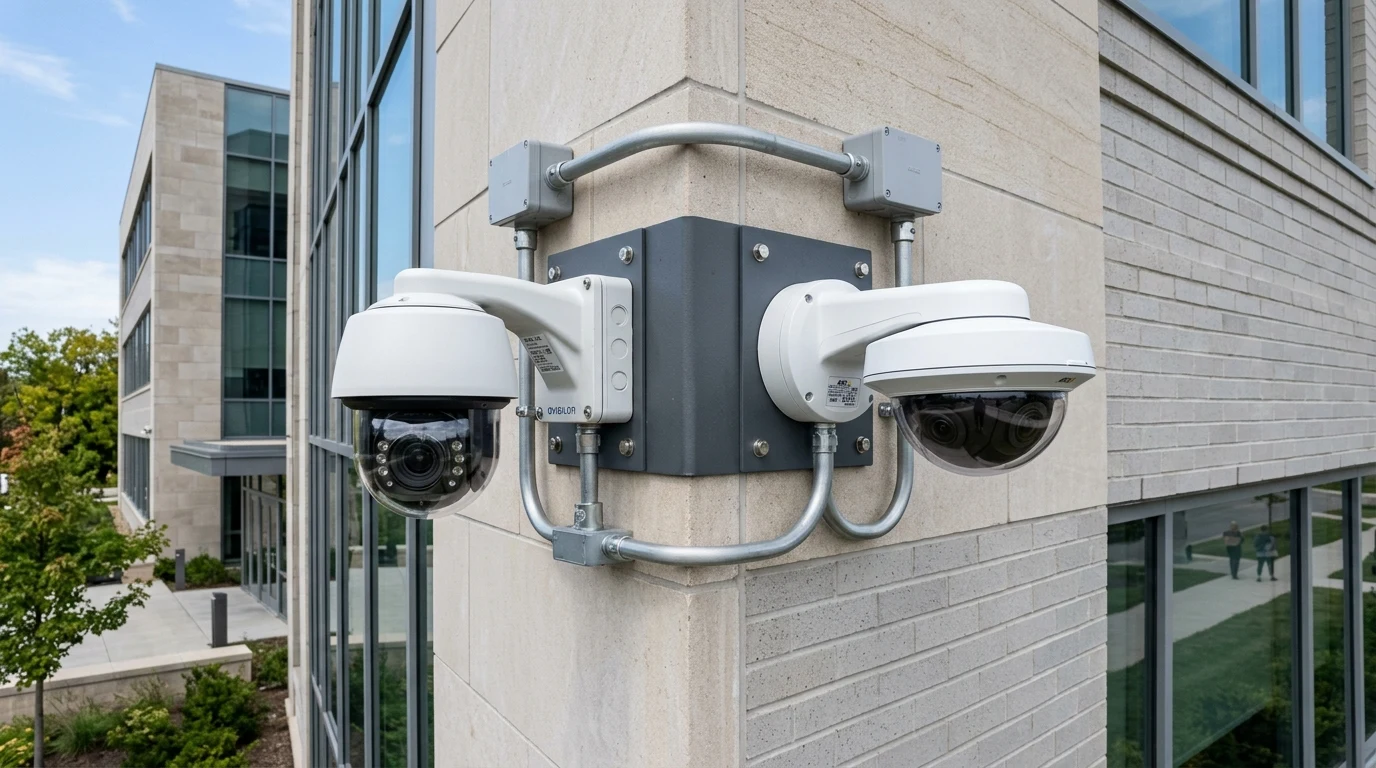
- Situational Blind Spot Differential: A Pan-Tilt-Zoom (PTZ) camera can only observe a single narrow field of view at any given millisecond; when zoomed into a target at 30x, 95% of the perimeter remains unmonitored. Multi-sensor panoramic cameras utilize 3 to 4 independent optical imagers stitched via DSP to record an uninterrupted, contiguous 180° or 360° coverage plane 24/7/365.
- DORI Pixel Density (Detection, Observation, Recognition, Identification): Identifying a human face or reading a license plate requires a minimum of 76 Pixels Per Foot (PPM/PPF). While a 4K multi-sensor camera maintains 80+ PPF up to 45 feet across a broad perimeter, a 30x optical PTZ achieves 150+ PPF at distances exceeding 400 feet, making PTZ mandatory for forensic long-range tracking.
- Mechanical Reliability & Mean Time Between Failures (MTBF): High-speed PTZ cameras contain mechanical belt drives, slip rings, stepping motors, and gearboxes that degrade in extreme weather (-30°C to +50°C), averaging an MTBF of 30,000 to 50,000 hours. Solid-state multi-sensor panoramic cameras contain zero moving parts, yielding an MTBF exceeding 100,000+ hours.
- Infrastructure Power Delivery (PoE++ / 802.3bt): High-power PTZ domes with integrated pan-tilt motors, optical defrosters, and long-range IR laser illuminators require IEEE 802.3bt Type 3/4 PoE++ (60W to 90W). Multi-sensor cameras typically operate within standard IEEE 802.3at PoE+ budgets (25.5W to 30W), slashing network switch power infrastructure costs.
What Is the Primary Difference Between PTZ and Multi-Sensor Panoramic Cameras?
The primary difference between a PTZ camera and a multi-sensor panoramic camera is that a PTZ offers deep optical magnification in a single directional cone, whereas a multi-sensor camera provides uninterrupted, contiguous situational awareness across 180° or 360° with zero mechanical moving parts and zero blind spots.
Designing an enterprise perimeter surveillance architecture for luxury estates, corporate campuses, or commercial warehousing demands rigorous forensic calculation. Security directors frequently succumb to the allure of high-speed Pan-Tilt-Zoom (PTZ) domes, assuming that automated patrol tours provide complete security coverage. In reality, relying on a roaming PTZ camera creates a critical operational flaw known as the patrol tour paradox: while the camera is pointed south tracking an innocent animal, an unauthorized breach occurs completely unrecorded to the north.
Conversely, multi-sensor cameras deploy three, four, or eight individual high-resolution image sensors inside a single weatherized enclosure, stitching the optical feeds together to provide seamless situational awareness. Deciding between these architectures—or deploying an integrated master-satellite pairing—requires forensic evaluation of pixel density, network infrastructure, and 5-year maintenance costs.
Engineering Comparison Matrix: Optical PTZ vs Multi-Sensor Array
Evaluating mechanical durability, power consumption, and forensic resolution across the perimeter deployment boundary:
| Architecture Dimension | Enterprise PoE++ Speed Dome PTZ | 4-Sensor 180° Panoramic Array | TCO & Security Impact |
|---|---|---|---|
| Continuous Field of View | Narrow Dynamic Cone (2.3° to 65° H-FOV) | Contiguous 180° or 360° Fixed Plane | Multi-sensor eliminates all patrol blind spots |
| Optical Zoom vs Digital Pixel Zoom | 25x to 45x Motorized Optical Zoom | Fixed Optical Focal Length / Digital E-PTZ | PTZ delivers 10x higher long-distance PPF |
| Mechanical Architecture | High-Speed Stepper Motors, Slip Rings, Belts | 100% Solid-State (Zero Moving Parts) | Multi-sensor offers 3x longer operational MTBF |
| Power Requirements (PoE Class) | IEEE 802.3bt Type 3/4 PoE++ (60W – 90W) | IEEE 802.3at PoE+ (25.5W – 30W) | Multi-sensor cuts switch power budget by 65% |
| Forensic Evidence Usability | Unusable if targeted away from breach point | Retrospective digital zoom across entire scene | Multi-sensor guarantees event capture in court |
| NVR Channels & Licensing Cost | 1 Camera License / 1 IP Address | 1 IP Address / 1 to 4 NVR Channel Licenses | Check VMS licensing model for multi-channel |
The DORI Standard: Mathematical Calculation of Forensic Pixel Density
Surveillance effectiveness cannot be assessed by sensor megapixel counts alone. The European Standard EN 62676-4 codifies the DORI framework, establishing the exact pixel density required to perform actionable forensic identification under law:
- Detection (25 px/m / ~8 px/ft): Enables an operator or deep-learning computer vision model to determine whether a human or vehicle is present in the scene.
- Observation (62 px/m / ~19 px/ft): Provides sufficient characteristic detail to observe human activity, such as clothing color or carrying a bag.
- Recognition (125 px/m / ~38 px/ft): Allows security personnel to determine with high certainty whether an individual matches a known employee or resident.
- Identification (250 px/m / ~76 px/ft): Delivers pristine forensic facial detail and license plate legibility beyond reasonable doubt in criminal court proceedings.
Consider the mathematical dilemma of a 300-foot perimeter boundary:
- A 4-Sensor 32MP (4x 8MP) Panoramic Camera:
Deploying 15,360 horizontal pixels across a 180° arc provides an outstanding 51 pixels per foot at a 50-foot distance (exceeding Recognition criteria). However, at 300 feet, the pixel density dilutes to approximately 8.5 pixels per foot—barely satisfying bare Detection standards. - A 4K 30x Optical PTZ Camera:
When parked in wide-angle mode, the PTZ covers only 60° of the perimeter with identical pixel dilution. However, when an intrusion is detected, the 30x optical zoom lens focuses all 3,840 horizontal pixels across a tight 12-foot horizontal target plane at 300 feet, delivering an astonishing 320 pixels per foot—surpassing facial Identification thresholds by more than fourfold.
Infrastructure Power Delivery: The 802.3bt PoE++ Reality
A frequent procurement failure in surveillance retrofits is under-sizing the network switch power budget for outdoor PTZ deployments:
- Cold-Climate Inrush & Defrosters: Outdoor PTZ cameras rated for Canadian and northern climates incorporate internal PTC heating elements and blower fans to keep the optical dome free of ice and condensation. In sub-zero conditions (-20°C), an industrial PTZ camera’s power draw surges from an idle 20 Watts to over 75 Watts.
- Switch Port Sizing (PoE++ / Type 4): Standard PoE (802.3af, 15.4W) and PoE+ (802.3at, 30W) network switches cannot boot an outdoor PTZ dome. Systems integrators must specify managed enterprise switches featuring IEEE 802.3bt Type 3 (60W) or Type 4 (90W) PoE++ ports. A 24-port PoE switch powering four PTZ cameras and twelve fixed cameras requires a minimum 740W power supply unit to prevent port-dropping power starvation during winter cold-starts.
- Multi-Sensor Power Efficiency: Because multi-sensor cameras contain no motorized gimbals or heavy mechanical defrosters, their power envelope remains constant at 18W to 26W across all seasons, allowing them to run reliably on affordable, standard 802.3at PoE+ infrastructure.
The Ideal Master-Satellite Hybrid Architecture: Automated Slew-to-Cue
Modern enterprise security systems no longer force an arbitrary choice between PTZ and panoramic cameras. The premier commercial and residential surveillance paradigm is the Automated Master-Satellite (Slew-to-Cue) Architecture:
- The Fixed Panoramic “Master”: A 4-sensor 180° panoramic camera is mounted at the property corner, continuously recording the entire grounds to local NVR storage. Local edge AI models running Frigate NVR or on-camera neural processing analyze the panoramic feed 24/7, tracking person and vehicle bounding boxes with zero blind spots.
- The Autonomous PTZ “Satellite”: Mounted co-located or slightly offset from the panoramic camera, a high-speed PoE++ PTZ dome sits in passive standby.
- The Slew-to-Cue Trigger: The moment a person breaches a geofenced tripwire on the panoramic camera’s coordinate plane, the VMS software transmits automated PTZ coordinates via ONVIF Profile S/T. The PTZ immediately slews at 400° per second to the target coordinates, optically zooms in at 30x, and tracks the intruder across the grounds, capturing pristine 250+ PPF facial evidence while the panoramic master records the holistic context of the entire incident.
Never deploy a solitary PTZ camera as the sole surveillance eye on an enterprise perimeter; the patrol tour paradox guarantees that critical security breaches will occur unrecorded while the camera is pointed elsewhere. Multi-sensor 180° panoramic cameras are the mandatory baseline for uninterrupted situational awareness and zero-blind-spot coverage with 100,000+ hour solid-state reliability. If your perimeter extends beyond 150 feet and demands courtroom-grade facial or license plate identification, deploy an automated Slew-to-Cue pairing: let the multi-sensor camera watch the world, and let the PoE++ PTZ zoom in for the forensic kill.
For companion security infrastructure teardowns, study our hardware analysis on PoE Security Cameras & Frigate NVR vs Ring & Nest, and review our automated power infrastructure guide on Online Double-Conversion UPS vs Line-Interactive AV.