⚡ Executive Surveillance Audit: Edge AI vs. Consumer Cloud
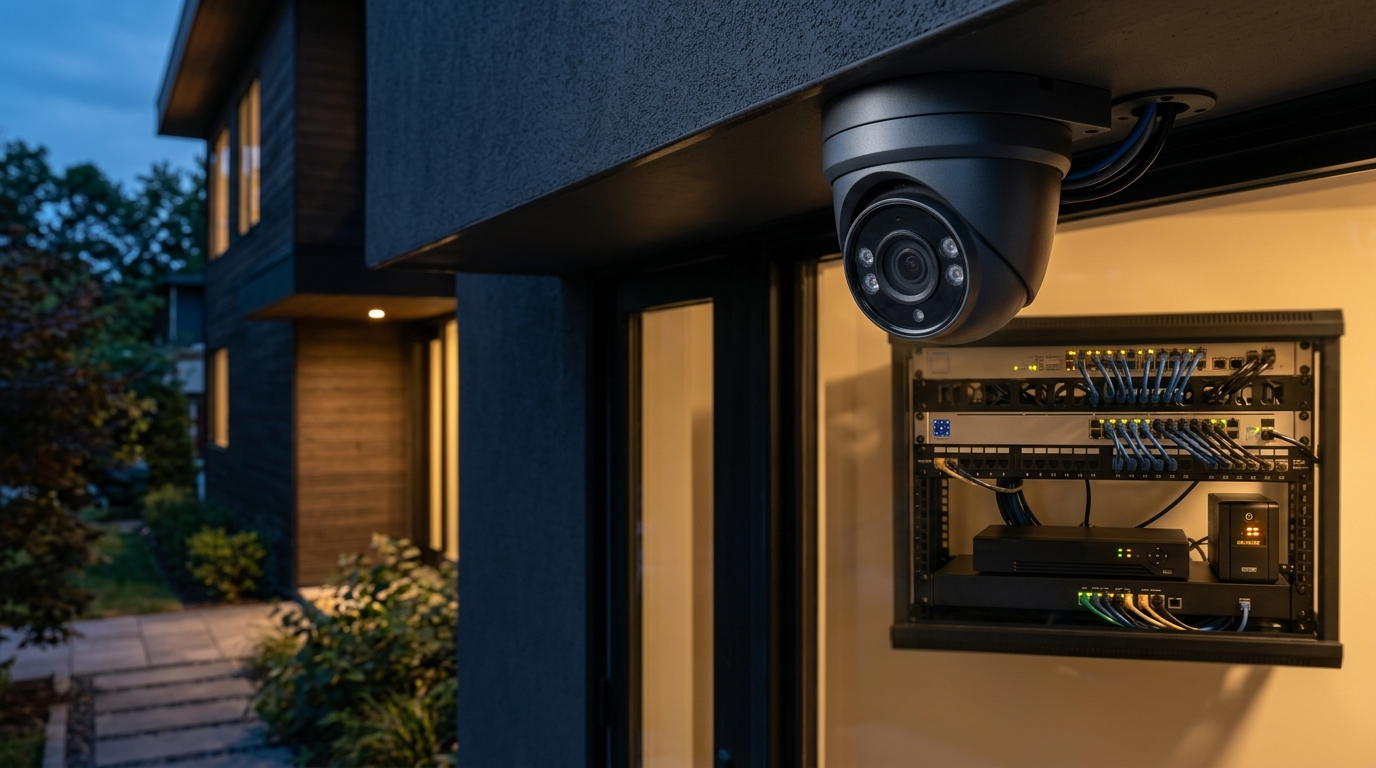
- Physical Layer: Category 6 Ethernet delivering IEEE 802.3af/at Power-over-Ethernet (PoE) up to 100 meters.
- AI Acceleration: Google Coral Edge TPU (PCIe / M.2 or USB) processing 100+ frames per second at under 2.5 watts.
- Video Architecture: Continuous 24/7 full-bitrate recording (4K / 12MP H.265) to local ZFS / enterprise SAS storage.
- Notification Latency: 12ms to 45ms on-device optical inference vs. 2,500ms to 8,000ms cloud push notification delay.
- 5-Year Ownership TCO: $680 hardware one-time investment vs. $1,840+ in escalating consumer cloud subscription fees.
Over 70 million residential security cameras deployed across North America suffer from three fatal design compromises: battery degradation, Wi-Fi channel congestion, and cloud-tethered recording. When an event occurs at your front door, a battery-powered Wi-Fi camera must wake its radio from deep sleep, negotiate a Wi-Fi handshake, upload compressed video to an external server farm, execute remote computer vision, and ping a push notification back to your smartphone.
By the time the notification chimes on your screen, 5 to 8 seconds have elapsed, and the subject has already departed. In contrast, prosumer Power-over-Ethernet (PoE) security cameras coupled with Frigate NVR and dedicated Edge TPU hardware operate in continuous real-time, delivering optical AI detection within milliseconds.
PoE Security Cameras & Frigate NVR vs. Ring & Nest: Cost & Latency Audit
Computer vision inference on video streams is mathematically demanding. Attempting to run object detection across six 4K camera streams on an x86 host CPU will immediately consume 100% of CPU cycles and generate massive thermal throttling. The industry solution is a dedicated Tensor Processing Unit (TPU).
Frigate NVR Configuration: Google Coral TPU Detector
mqtt:
  enabled: true
  host: 192.168.10.5

detectors:
  coral:
    type: edgetpu
    device: pci:0

cameras:
  driveway_turret:
    ffmpeg:
      inputs:
        - path: rtsp://admin:pass@192.168.30.20:554/Preview_01_main
          roles:
            - record
        - path: rtsp://admin:pass@192.168.30.20:554/Preview_01_sub
          roles:
            - detect
    detect:
      width: 1280
      height: 720
      fps: 5
    objects:
      track:
        - person
        - car
        - dog
By feeding low-resolution substreams (e.g., 720p at 5 FPS) into the Google Coral Edge TPU while recording the pristine 4K 25 FPS mainstream directly to disk, the Coral executes tensor inference in a blistering 8.2 milliseconds per frame while the host CPU hovers at under 5% utilization.
Five-Year TCO Audit: Local PoE Frigate NVR vs. Consumer Cloud Subscriptions
The financial disparity between consumer subscription cameras (Ring Protect, Nest Aware) and a local PoE NVR system becomes staggering when calculated over a standard five-year residential ownership cycle:
| Architecture Category | Ring / Nest Cloud (6 Cameras) | Reolink PoE + Frigate TPU (6 Cameras) |
|---|---|---|
| Upfront Hardware Cost | $899 (Cameras + Chimes + Solar Mounts) | $780 (6x 4K Turrets + PoE Switch + Coral) |
| 5-Year Subscription Fees | $1,200 – $1,800 ($200–$300/yr plan) | $0.00 (Self-Hosted) |
| Recording Architecture | Motion clips only (Misses pre-roll) | 24/7 Continuous 4K H.265 Recording |
| Privacy & Third-Party Access | Cloud stored; subject to subpoena/terms | Encrypted local ZFS array; 100% private |
| Total 5-Year Investment | $2,099 – $2,699 | $780 Total |
3. The Unified Smart Ecosystem Synergy
When you detach your cameras from corporate cloud silos, your surveillance system transforms into an active automation trigger. By integrating Frigate MQTT events directly into a zero-cloud Home Assistant local environment, a verified person entering the driveway instantly ramps architectural landscape lighting and broadcasts an offline audio chime through in-ceiling speakers.
Crucially, high-performance surveillance infrastructure requires continuous electrical stability. Wiring your PoE network switch and NVR appliance through a dedicated circuit monitored by a smart electrical panel like SPAN or Schneider Square D ensures security cameras remain prioritized during power outages, shedding heavy HVAC loads to preserve camera recording runtime.
Frequently Asked Questions (PoE Surveillance & Frigate NVR)
Yes. The gold-standard method for secure remote access in 2026 is deploying Tailscale or WireGuard VPN. By establishing an encrypted peer-to-peer tunnel, you can stream low-latency 4K feeds to your mobile device from anywhere in the world without exposing open ports or paying cloud relay fees.
A Google Coral USB or M.2 TPU performs 4 trillion operations per second (4 TOPS) at just 2 watts of power. It offloads real-time object detection (detecting persons, cars, animals) from the host CPU, allowing a cheap mini PC to process dozens of high-resolution video streams simultaneously with inference times under 10ms per frame.
Turret (eyeball) cameras eliminate the exterior glass dome that causes severe infrared glare, water droplet buildup, and spiderweb accumulation common on traditional dome cameras. They offer superior weather resistance and discrete aesthetics for residential architecture.
Utilizing efficient H.265 compression at 25 FPS with an 8,192 kbps bitrate, each 4K stream consumes approximately 86GB per day. Six cameras generate ~516GB daily. A 16TB surveillance hard drive (such as a Western Digital Purple Pro or Seagate SkyHawk AI) delivers approximately 30 days of uninterrupted continuous recording history.
Yes. Frigate integrates seamlessly with Home Assistant via MQTT and the Frigate Custom Integration. It creates binary occupancy sensors for people and vehicles, real-time snapshot thumbnails, and actionable mobile notifications with sub-second delivery speed.