
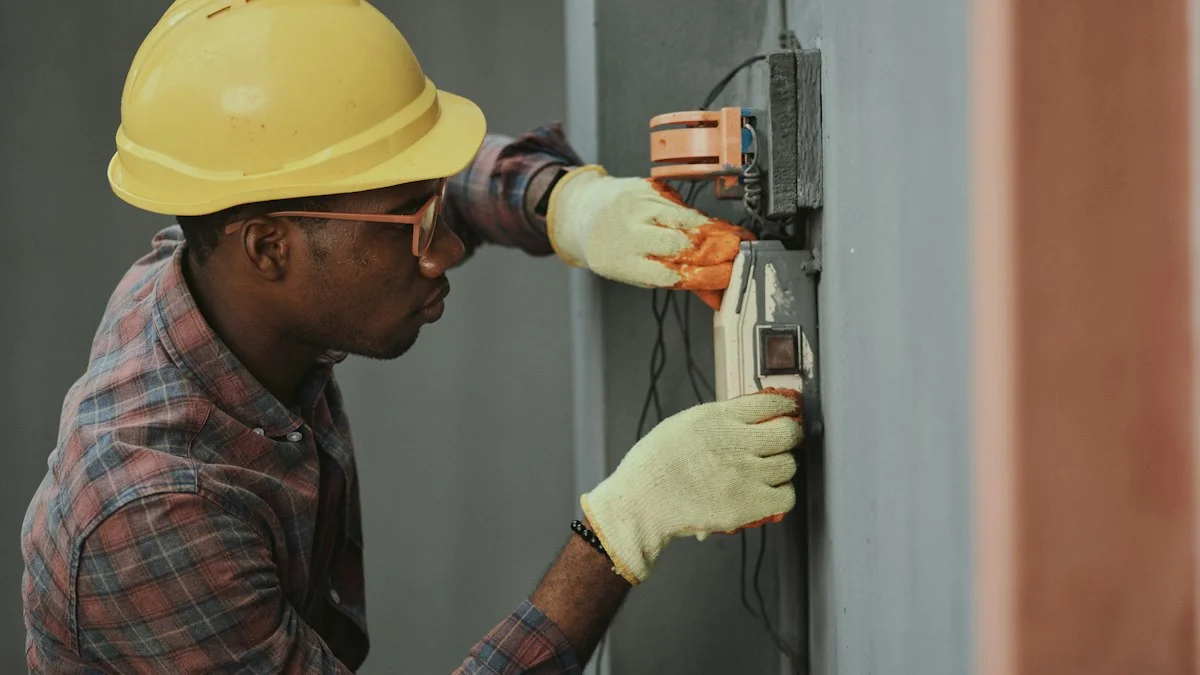
Nothing shatters the illusion of high-end home theater audio or high-fidelity stereo listening faster than an incessant, low-frequency 60 Hz hum buzzing through your subwoofers or electrostatic speakers. Enthusiasts frequently spend thousands of dollars on exotic boutique audio interconnects and power cables trying to eradicate the noise, only to discover the culprit originates inside their home’s electrical panel. Building an uncompromising, ultra-low noise floor requires a dedicated 20-amp branch circuit engineered specifically for sensitive audiovisual electronics.
How Do You Eliminate 60Hz Ground Loop Hum in High-End AV Racks?
The root cause of 60 Hz hum in residential audio installations is the phenomenon known as a ground loop. When multiple AV components (such as an AV preamplifier processor, multiple power amplifiers, active subwoofers, and cable set-top boxes) are plugged into different electrical outlets on different household branch circuits, slight differences in earth ground impedance create a potential voltage difference between the chassis of each device. Because standard RCA audio interconnect shields are directly bonded to equipment signal ground, stray electrical current travels across the audio cable shield, inducing audible 60 Hz AC hum and 120 Hz harmonic buzz directly into the audio pre-amplification stage.
Beat 2: The Costly Trap & Architectural Nuance Matrix
The most dangerous and legally hazardous mistake AV enthusiasts make when trying to eliminate ground loop hum is using a “cheater plug” (a 3-prong to 2-prong grounding adapter) to lift the safety ground pin on a power amplifier. While lifting the mechanical ground pin breaks the ground loop circuit and silences the hum, it completely removes the equipment’s primary electrical life-safety barrier.
If an internal transformer insulation failure or short-circuit occurs inside an amplifier with an ungrounded chassis, the metal enclosure becomes energized with 120 volts of lethal alternating current. Touching the amplifier chassis and an interconnected grounded component creates a direct cardiac shock path. Never bypass safety grounding; fix the underlying circuit architecture instead.
| Power Architecture Element | Standard 15A Convenience Circuit | Dedicated 20A Isolated Ground Run | Acoustic & Electrical Benefit |
|---|---|---|---|
| Conductor Wire Gauge | 14 AWG (High internal impedance) | 12 AWG or 10 AWG Solid Copper | Reduces voltage drop during high bass transients |
| Shared Electrical Loads | Shared with fridge, dimmers, fans | 100% Isolated to AV Equipment Rack | Zero triac dimmer hash or motor switching noise |
| Panel Phase Alignment | Random split phases across rooms | Identical Electrical Phase (Leg A or B) | Eliminates 120V phase-to-phase ground voltage delta |
| Outlet Construction | Standard Residential Push-In Backstab | Hospital-Grade Isolated Ground (IG) | High-tension beryllium copper contacts; low ESR |
| Transient Power Capacity | 1,800 Watts max (1,440W sustained) | 2,400 Watts max (1,920W sustained) | +33% dynamic continuous power headroom |
Field Installation & Hardware Commissioning Protocol
When working with a licensed electrician to execute clean power infrastructure for your theater or listening room, execute these four critical steps:
- Pull Home-Run 12/2 Romex to the Equipment Rack: Instruct your electrician to run continuous, uninterrupted 12 AWG solid copper Romex (or 10 AWG for cable runs exceeding 75 feet) from the main breaker panel directly to your AV equipment rack location without intermediate junction boxes or daisy-chained receptacles.
- Align Dedicated Circuits on the Same Breaker Leg: If your equipment requires multiple circuits (for instance, one 20A circuit for high-current power amplifiers and a second 20A circuit for low-level source processors and video projectors), install the breakers in adjacent tandem slots on the same electrical phase (either Leg A or Leg B). Powering interconnected AV components from opposite phases creates an instantaneous 240V potential across component grounds, exacerbating ground loops.
- Install a Dedicated Isolated Ground (IG) Receptacle: Install an orange-faced Hospital-Grade Isolated Ground duplex receptacle (such as Hubbell IG5362). In an isolated ground receptacle, the equipment grounding terminal is physically decoupled from the metallic wall box and building conduit. Run an insulated green ground conductor directly back to the main service panel earth bus bar, protecting the AV rack from electrical noise conducted through building metal framing.
- Standardize on Balanced XLR Audio Interconnects: Single-ended RCA cables transmit audio relative to the cable shield. Balanced XLR cables transmit equal and opposite audio signals across two dedicated conductors (Pin 2 Hot, Pin 3 Cold), while the chassis ground shield (Pin 1) carries no audio information. The differential amplifier input stage automatically cancels common-mode ground noise via Common-Mode Rejection Ratio (CMRR), rendering ground hum physically inaudible.
CATV Cable Ground Isolation Guardrail
One of the most insidious sources of 60 Hz hum originates outside your home: incoming coaxial cable lines from cable TV or high-speed internet providers. If the utility provider’s exterior ground rod is not bonded to your home’s main electrical earth ground with heavy 6 AWG copper conductor, a massive earth potential difference develops. Plugging an HDMI cable from your cable box into your AV processor injects this ground current straight into your audio chain. Installing an inexpensive coaxial ground loop isolator (such as the Jensen VR-1FF) breaks this external ground path while passing high-bandwidth RF frequencies with zero signal degradation.
Toroidal Transformer Saturation & Mechanical DC Offset
In high-performance audiophile audio and multi-channel home theater amplifiers, massive toroidal power transformers are widely favored for their low stray magnetic field radiation and instantaneous current delivery. However, toroidal cores possess an inherent design vulnerability: extreme sensitivity to direct current (DC) offset present on municipal alternating current (AC) power grids. Modern household appliances—including hair dryers, variable-speed heat pumps, LED dimmer circuits, and microwave ovens—often draw current asymmetrically across AC waveform cycles, inducing several hundred millivolts of DC voltage onto household electrical lines.
When even 200mV of DC enters a heavy toroidal transformer primary winding, the magnetic core is pushed toward magnetic saturation. This causes the physical transformer core laminations to vibrate violently at 120 Hz, producing an irritating mechanical buzzing sound radiating directly from the amplifier chassis, completely independent of the audio speakers. Installing a dedicated DC blocker (mains DC trap) utilizing high-current bridge rectifiers and high-capacitance electrolytic filtering capacitors ahead of the amplifier blocks DC voltage while allowing clean, uncompressed AC current flow, instantly restoring silent mechanical amplifier operation.