
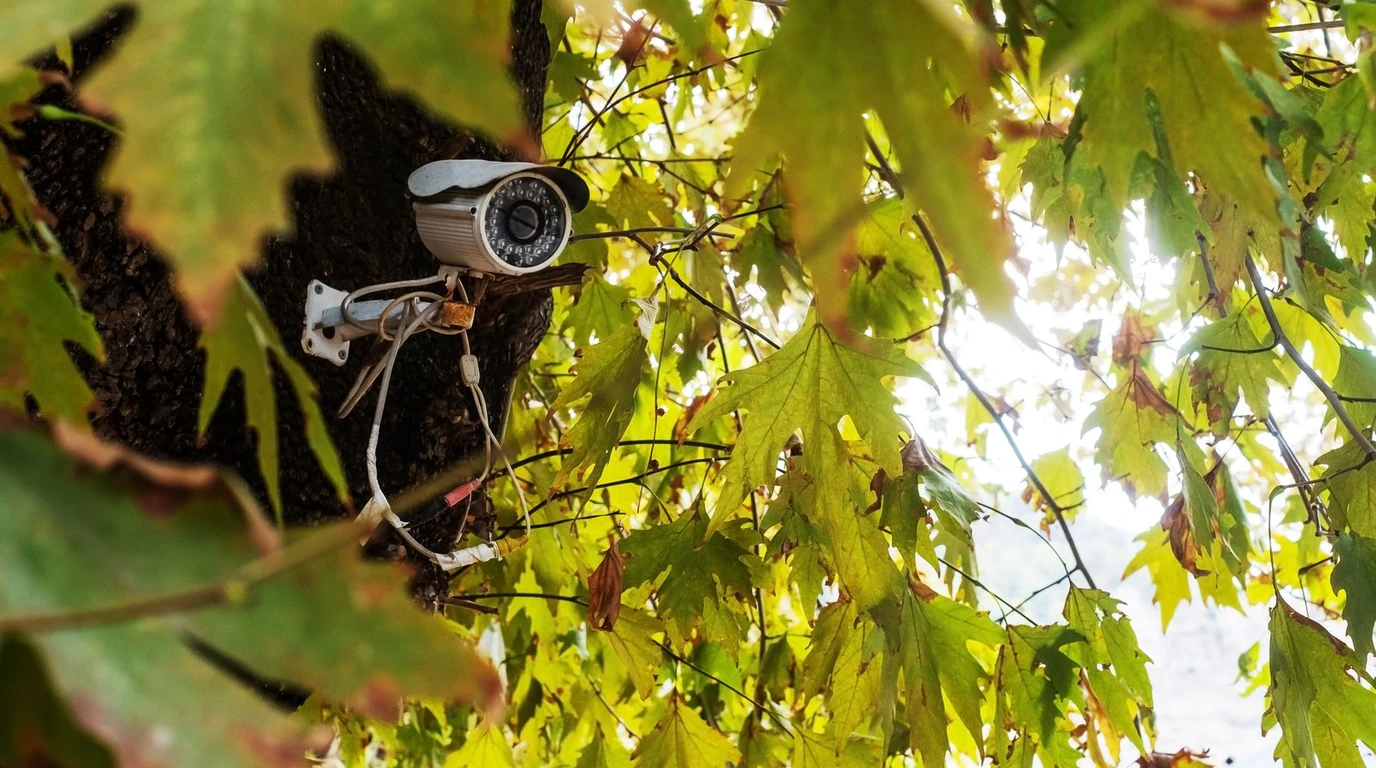
Standard 4K overview security cameras fail at License Plate Recognition (LPR) because their automatic exposure algorithms drop shutter speeds to 1/30s at night, causing total vehicle motion blur and severe retroreflective IR flare blowouts. Reliable ALPR requires a dedicated varifocal camera equipped with a large optical sensor (e.g., 1/1.8″ Sony STARVIS 2), an ultra-fast manual shutter locked between 1/1000s and 1/2000s, specialized infrared bandpass illumination, and a local edge-AI inference pipeline running Frigate, Plate Recognizer, or OpenALPR.
The Anatomy of Nighttime LPR Failure: Why 4K Cameras Go Blind
Property owners and security technicians frequently make the costly mistake of purchasing premium 4K or 12-megapixel ultra-wide-angle security cameras under the assumption that higher pixel counts guarantee legible license plate captures. In real-world field conditions, standard commercial security cameras fail to read license plates on moving vehicles over 95% of the time after dusk.
The failure is driven by physics, not resolution. Modern consumer and prosumer cameras prioritize scene illumination over motion freezing. In low-light environments, the camera’s automatic exposure algorithm widens the aperture, maxes out sensor gain (introducing massive digital noise), and extends exposure duration down to 1/30th or 1/15th of a second. When a vehicle passes at 35 km/h (approx. 10 meters per second), the vehicle travels 33 centimeters while a single video frame is being captured. This results in catastrophic horizontal motion blur that smears alphanumeric characters into an unreadable gray haze.
Compounding this problem is the retroreflective coating mandated on modern motor vehicle license plates. Designed to bounce automotive headlights directly back to their source, license plates act as intense optical retroreflectors. When a standard camera’s integrated 850nm infrared LEDs hit a retroreflective plate, the plate reflects pure white light back into the sensor, blowing out the dynamic range and turning the entire plate into a solid white glowing rectangle.
Optical Engineering: Sensor Size, Shutter Timing & Pixels On Target (PPF)
To successfully capture crisp license plate images, surveillance architects follow strict physical engineering guidelines governed by the Pixels Per Foot (PPF) standard. For reliable Automatic License Plate Recognition (ALPR) optical character recognition algorithms, the capture camera must deliver a minimum of 60 to 80 Pixels Per Foot across the capture zone.
| Camera Tuning Metric | General Surveillance Camera | Dedicated Optical LPR Camera |
|---|---|---|
| Sensor Architecture | 1/2.8″ or 1/3″ High-Megapixel | 1/1.8″ Low-Light (e.g. Sony STARVIS 2) |
| Lens & Focal Length | 2.8mm – 4.0mm Fixed Wide-Angle | 8mm – 32mm / 12mm – 50mm Motorized Varifocal |
| Electronic Shutter Speed | Auto (1/30s – 1/60s at night) | Manual Locked: 1/1000s to 1/2000s |
| Target Pixel Density | 15 – 30 Pixels Per Foot (Overview) | 60 – 100 Pixels Per Foot (Tight Choke Point) |
| Night Video Appearance | Bright scene, blurred white-out plates | Pitch black background, high-contrast crisp text |
| Horizontal Capture Angle | Wide (> 90 degrees) | Narrow (< 20–30 degrees to roadway) |
When properly locked to 1/1000s shutter speed at night, an LPR camera’s video feed will appear pitch black to human viewers. The surrounding trees, driveway, and vehicle body will be completely invisible. Only the retroreflective plate numbers, illuminated by high-powered infrared illuminators, will appear brightly against the dark sensor background. This is expected and required behavior: an LPR camera is a character digitizer, not an environmental observation tool. Professional installations always deploy a paired two-camera setup: one dedicated LPR camera locked at high shutter speeds to read characters, and one wide-angle overview camera to capture vehicle color, make, and occupant details.
Mounting Geometry: Eliminating the Cosine Angle Error
The geometric position of an LPR camera relative to the vehicle’s direction of travel dictates recognition accuracy. If the camera is mounted too high on a roof eave or angled sharply from a side lawn, the effective pixel width of the plate is mathematically compressed, and license plate characters appear skewed to the OCR model.
- Vertical Angle Limit: The vertical inclination angle between the camera lens and the vehicle bumper must not exceed 20 to 25 degrees. Mounting cameras on second-story rooflines introduces extreme downward angles that obscure plates beneath trunk overhangs.
- Horizontal Off-Axis Angle Limit: The horizontal angle between the camera lens axis and the vehicle centerline must remain under 20 to 30 degrees. As the vehicle turns through a sharp radius, optical distortion degrades character aspect ratios.
- Choke-Point Deployment: Always position LPR cameras at natural vehicular choke points—such as property entrance gates, speed bumps, curved driveway throttles, or stop signs. Positioning cameras where vehicles naturally decelerate increases the number of viable capture frames per second.
Local Deep Learning Inference: Frigate NVR, Edge TPUs & Plate Recognizer
Once high-contrast, motion-free frames are delivered over RTSP, they must be processed by an optical inference pipeline. Historically, ALPR required expensive proprietary server hardware running closed-source vendor software like Genetec AutoVu or Vigilant Solutions. In 2026, self-hosted edge AI hardware has completely democratized institutional-grade ALPR.
Modern local-first architectures utilize Frigate NVR integrated with a hardware AI accelerator—such as a Google Coral Dual Edge TPU or an Intel 13th/14th Gen iGPU running OpenVINO. When Frigate’s real-time object detection model detects a vehicle entering an active motion zone, it crops the bounding box coordinates and dispatches the highest-resolution keyframe to a local containerized OCR inference service:
- Local Plate Recognizer Snapshot SDK: A containerized Docker microservice running on the local network that accepts image snapshots via REST API and returns license plate strings, issuing jurisdictions (e.g., US states, Canadian provinces), and confidence scores in under 80 milliseconds.
- OpenALPR / Rekor Watchman: Open-source and commercial edge packages optimized for continuous real-time video stream decoding and plate clustering.
- Home Assistant Automation Siphoning: Once a plate is digitized, Frigate or Plate Recognizer publishes the recognized plate string via MQTT to Home Assistant. Automations can immediately cross-reference known household plates, open security access gates, disarm perimeter intrusion sensors, and log unknown guest arrivals into an encrypted local database.
Never expect an overview camera to read license plates at night. For reliable perimeter license plate logging, install a dedicated 1/1.8″ sensor motorized varifocal camera (such as the EmpireTech/Dahua IPC-HFW5241E-Z12E or UniFi AI DSLR), lock the electronic shutter manually to 1/1000s, narrow the field of view directly onto a driveway choke point at under 25 degrees, and pipe the RTSP snapshot stream into a local Frigate NVR edge TPU cluster running Plate Recognizer.
To optimize your surveillance compute cluster and select the ideal hardware acceleration for edge inference, read our complete forensic audit on Frigate NVR: Dual Edge TPU vs Intel iGPU OpenVINO, and check our comparative benchmark on PoE security cameras vs cloud consumer doorbells.