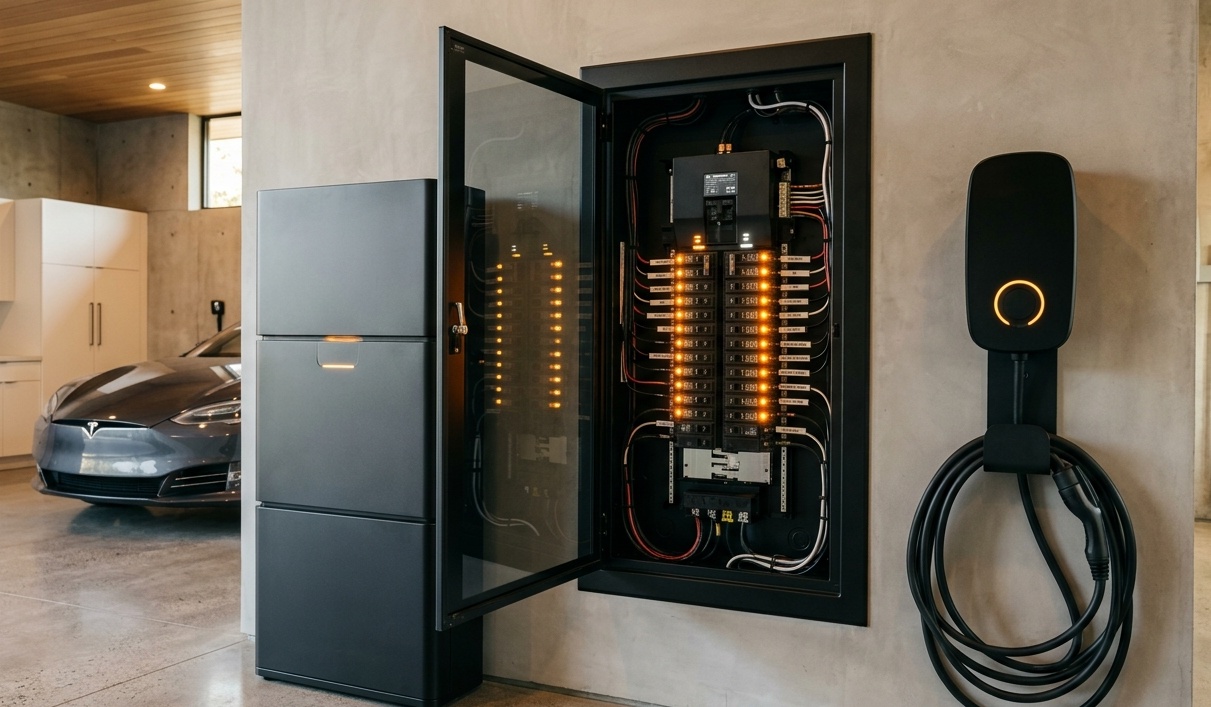
- The Modular vs. Monolithic Tradeoff: Schneider Electric’s Square D Energy Center uses modular smart breakers and plug-on neutral CT monitoring (Wiser Energy), allowing gradual per-circuit upgrades at $80–$140 per breaker. SPAN Panel replaces the entire load center with a 32-circuit solid-state digital relay architecture ($3,500+ base hardware).
- Automated Dynamic Load Shedding: SPAN provides millisecond-level automated circuit shedding during grid outages directly via software profiles. Square D requires connected smart relays or specific connected breakers to physically interrupt power, focusing heavily on continuous energy telemetry and EV optimization.
- Local Integration Integrity: Both ecosystems expose local telemetry to Home Assistant via Modbus/Matter or local API integrations, enabling local solar-to-battery balancing without cloud latency.
As residential homes electrify with heat pumps, dual 48A Level-2 EV chargers, and whole-home battery backup systems (such as Tesla Powerwall 3 or Enphase 5P), traditional mechanical breaker panels have become the ultimate bottleneck of modern smart infrastructure. The central challenge is no longer just distributing 200A of service—it is managing peak simultaneous load without triggering expensive utility service upgrades to 400A.
Homeowners and integrators frequently evaluate Square D Smart Panels (Schneider Electric QO and Homeline Energy Center ecosystems) against the category-defining SPAN Panel. Deciding between these two smart power architectures requires auditing retrofit feasibility, circuit-level actuation, and battery backup longevity.
Architectural Comparison: Square D (Schneider) vs. SPAN Panel
| System Metric | Square D Energy Center (Schneider Electric) | SPAN Smart Electrical Panel |
|---|---|---|
| Hardware Architecture | Hybrid: Standard QO/Homeline load center with modular smart breakers & Wiser CT hubs. | Fully Integrated: 32 individual solid-state digital relay control channels. |
| Circuit-Level Actuation (Remote On/Off) | Optional: Only circuits equipped with motorized connected smart breakers can switch remotely. | Standard: 100% of all 32 circuits can be dynamically controlled and shed via software. |
| Hardware Base Cost | $1,200 – $2,200 (Enclosure + Wiser Hub + initial smart breakers). | $3,500 – $4,500 (Base panel unit before labor & permits). |
| Retrofit Flexibility | Extreme: Can retrofit existing Square D QO panels with smart relays without whole-panel teardown. | Requires complete replacement of the existing main or sub-panel enclosure. |
| Local Automation Protocol | Modbus TCP, Schneider Wiser Local API, Matter bridging. | Local Ethernet/Wi-Fi REST API, Home Assistant SPAN Integration. |
Dynamic Load Shedding: Why It Dictates Battery Survival Time
In a standard grid outage, an oversized 200A panel backed up by a 13.5 kWh battery can be exhausted in less than 4 hours if a heat pump, electric dryer, and water heater cycle simultaneously. Traditional electrical design addresses this by installing an “essential loads subpanel,” physically wiring only critical circuits to the battery.
Smart electrical panels eliminate physical subpanels entirely through software-defined priority shedding:
- SPAN Panel Execution: In an outage, SPAN’s software automatically demotes non-essential circuits (HVAC, EV charger, pool pumps) into low-priority tiers. If battery state-of-charge (SoC) drops below 50%, SPAN shuts down tier-2 circuits instantly without mechanical breaker tripping, extending battery runtime from 6 hours to 48+ hours.
- Square D Wiser Execution: Schneider achieves load management through connected Control Relays and smart EV charging stations. When the Wiser hub detects aggregate power approaching the panel’s 200A main threshold, it commands the EV charger to throttle down from 48A to 16A, avoiding panel overload while keeping primary circuits energized.
For an overarching review comparing SPAN against Leviton and Schneider, read our baseline evaluation of Smart Electrical Panels: SPAN vs. Schneider Square D vs. Leviton.
Local-First Integration with Home Assistant
Neither luxury homeowners nor mission-critical facilities can afford to depend on cloud servers to manage high-voltage electrical infrastructure. If internet connectivity drops during a storm, automated power management must continue functioning locally.
The Home Assistant ecosystem natively interfaces with both systems. For SPAN panels, the local integration queries the panel’s onboard web server over LAN, extracting per-phase voltage, frequency, and real-time active power (Watts) for each of the 32 circuits at 1-second intervals. For Square D installations utilizing Schneider PowerTag energy sensors, local Modbus TCP gateways push telemetry directly into Home Assistant’s Energy Dashboard without transmitting data outside your home network.
To design an entirely cloud-independent ecosystem, see our blueprint on Building the Zero-Cloud Smart Home with Local Voice & Home Assistant.
Frequently Asked Questions (PAA Direct Answers)
Yes. If your home already has a Square D QO or Homeline panel with plug-on neutral architecture, you can install Schneider Wiser Energy smart monitoring modules and connected relays without replacing the metal panel enclosure or pulling new home run wiring, dramatically reducing installation labor.
In most jurisdictions, yes. Under NEC 220.87 rules and automated energy management provisions, smart panels with dynamic load shedding can mathematically prove that continuous demand will never exceed the 200A service rating, allowing electricians to add high-draw EV chargers and heat pumps without paying tens of thousands of dollars for utility transformer and trenching upgrades.
If you are performing a full architectural renovation, installing solar plus storage, and demanding total software control over every single breaker from a tablet, SPAN Panel is the undisputed leader in solid-state energy intelligence. However, for existing homes with Square D infrastructure looking for cost-effective electrical monitoring, EV load throttling, and selective breaker control without a $10,000 all-in electrical service overhaul, Square D Energy Center with Schneider Wiser delivers the smartest, most pragmatic path forward.