⚡ Executive Infrastructure Blueprint: The 30-Year Backbone
- Physical Topology: Star network routing from a central utility rack with OS2 single-mode fiber backbones and Cat6A horizontal runs.
- Bandwidth Capacity: 10 Gigabit-per-second (10GBASE-T / 10G SFP+) symmetrical routing throughout all primary living zones.
- PoE Budgeting: IEEE 802.3bt (PoE++ up to 90W) to power Wi-Fi 7 access points, motorized shades, and edge AI cameras.
- Thermal Management: Forced-air active rack ventilation maintaining sub-32°C ambient temperatures for continuous hardware longevity.
When architects and custom home builders design luxury multi-million-dollar residences, immense attention is devoted to Italian marble countertops, custom millwork, and automated fenestration. Yet the single most critical utility determining whether a modern home functions smoothly or suffers from daily technical paralysis is hidden behind the drywall: the structured low-voltage cabling plant.
Relying on Wi-Fi alone to distribute 8K uncompressed video, tens of thousands of IoT sensor telemetry packets, multi-camera 4K security feeds, and multi-gigabit fiber internet is a catastrophic engineering mistake. In 2026, building an elite residential infrastructure requires a dual-layer cabling plant: OS2 single-mode fiber-optic backbones paired with shielded Category 6A (Cat6A) copper terminated in an enterprise patch rack.
1. Copper vs. Fiber: The Residential Hybrid Model
| Cabling Standard | Max Bandwidth / Distance | Power Delivery (PoE) | Primary Residential Application |
|---|---|---|---|
| Cat6A (Shielded F/UTP) | 10 Gbps up to 100 meters | Yes (PoE++ up to 90W) | Wi-Fi 7 APs, IP cameras, touchscreens, wall jacks |
| OS2 Single-Mode Fiber | 100 Gbps+ (Multi-kilometer) | No (Requires separate power) | Inter-rack backbones, detached garages, AV suites |
| Legacy Cat5e / Cat6 | 1 Gbps (Cat6 10G limited < 37m) | Basic PoE (15W–30W) | Obsolete; avoid in new luxury construction |
Copper cabling remains indispensable for horizontal drops because of its ability to transmit high-wattage DC electrical power alongside high-speed data. A modern Wi-Fi 7 ceiling access point or an edge-AI optical camera requires 25W to 45W of continuous PoE power. However, running copper lines between detached guest houses, pool cabanas, or secondary garages introduces lightning and ground-loop hazards. Connecting outbuildings strictly with non-conductive OS2 single-mode fiber via SFP+ transceivers guarantees complete electrical isolation.
2. Centralized AV Rack Architecture & Cable Management
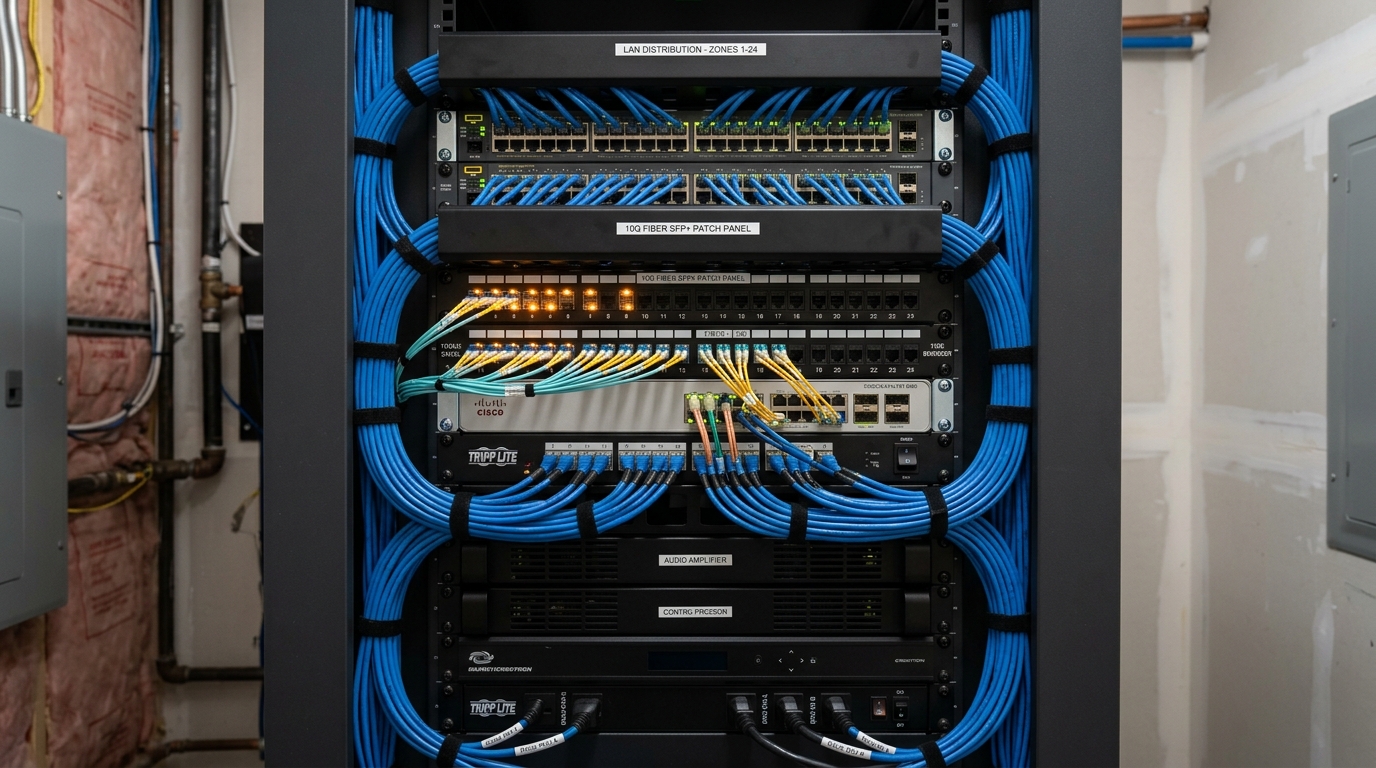
Low-voltage wiring should never terminate haphazardly on plastic wall plates behind entertainment consoles. All structured cables must terminate in a centralized, grounded 19-inch equipment rack located in a climate-controlled mechanical room.
Adhering to professional integration standards:
- Keystone Patch Panels: Utilize 24-port shielded keystone patch panels rather than punchdown blocks, allowing individual module replacement without disturbing adjacent wiring bundles.
- Continuous Hook-and-Loop Dressing: Secure cable bundles with velcro straps—never plastic zip ties, which crush internal wire twists and degrade high-frequency alien crosstalk performance.
- Service Loops: Provide a 3-meter slack service loop at the head-end to accommodate future rack relocations.
This organized physical layer forms the communications bedrock for whole-home surveillance managed by PoE security cameras running Frigate NVR edge AI and acoustic streaming tuned via Dirac Live spatial acoustic calibration.
3. Electrical Resiliency & Smart Panel Protection
An enterprise residential AV rack pulling 800 to 1,500 continuous watts represents a high-value investment. Powering this infrastructure requires uninterrupted battery protection and automated load management.
Integrating your rack circuits with smart electrical breaker panels like SPAN and Leviton ensures that during municipal grid power cuts, whole-home battery reserves prioritize your communications rack, maintaining Wi-Fi, internal phone lines, and smart home automation for days.
Chief Systems Analyst’s Verdict
Structured cabling is the one infrastructure asset you cannot easily upgrade once the drywall is painted. For any home renovation or new build in 2026, install a minimum of two shielded Cat6A drops to every television and desk location, pull dual OS2 single-mode fiber to all outbuildings, and centralize everything in a grounded 42U rack.
People Also Ask (PAA)
Why choose Cat6A over Cat6 for residential installations?
Cat6A supports full 10 Gigabit speeds up to the maximum 100-meter (328 ft) distance and features internal physical shielding to eliminate alien crosstalk, whereas standard Cat6 degrades to 1 Gigabit beyond 37 to 55 meters in high-density bundles.
Should I run single-mode or multi-mode fiber in a home?
Always choose OS2 single-mode fiber. While OM3/OM4 multi-mode fiber was historically common in data centers, single-mode fiber optics have reached price parity and provide essentially infinite bandwidth, eliminating future fiber obsolescence.
Does 10GbE copper generate excessive heat?
10GBASE-T copper transceivers consume 2.5W to 4W each and run noticeably warmer than 1 Gbps ports. In residential racks, utilizing direct SFP+ DAC twinaxial copper cables or optical SFP+ transceivers for inter-switch connections reduces heat and power consumption by over 60%.