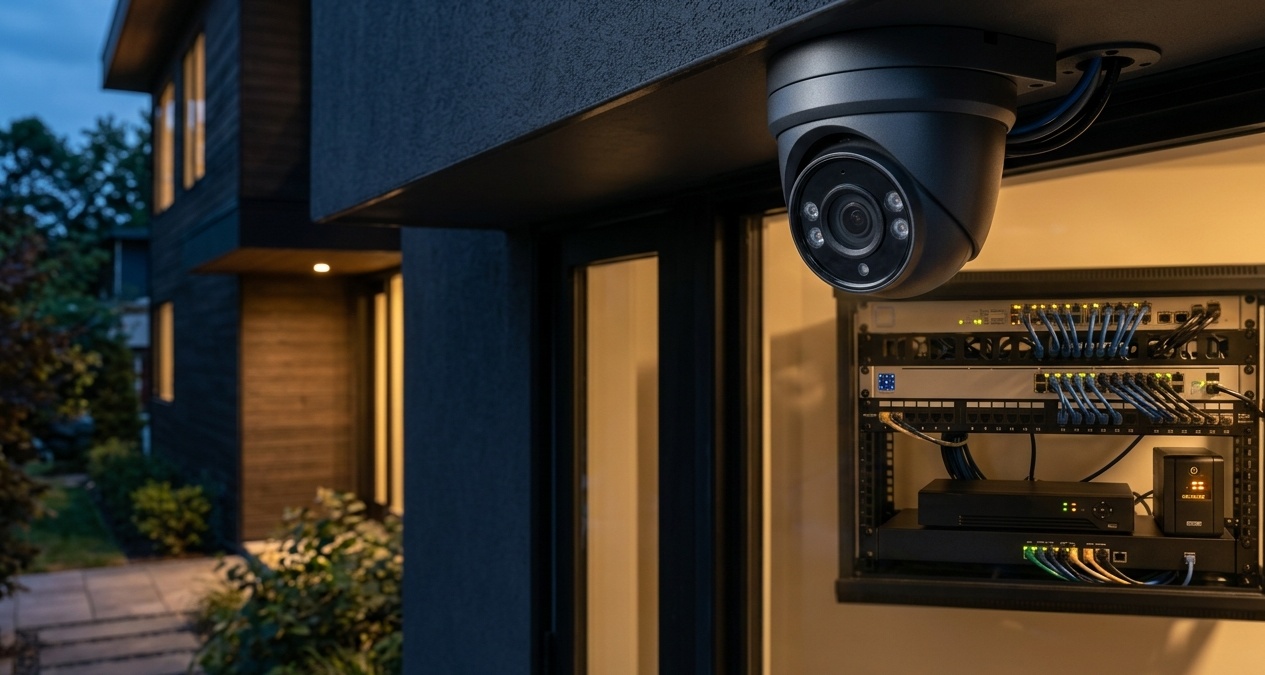
- Google Coral TPU Efficiency: The Coral Edge TPU ASIC delivers 4 TOPS of INT8 inference power at just 2 Watts, processing 300×300 MobileNet SSD object detection frames in 7ms to 11ms without loading host CPU cores.
- Intel OpenVINO GPU Acceleration: On modern 12th-to-14th Gen Intel or N100 processors, Intel’s integrated UHD/Iris Xe graphics using OpenVINO achieve comparable 9ms to 14ms inference speeds, eliminating the need to hunt for scarce Coral hardware.
- Multi-Camera Scaling Thresholds: A single Coral TPU comfortably handles up to 8 to 12 active 4K PoE detection streams (evaluating 5fps sub-streams). Beyond 12 cameras, dual M.2 Coral cards or dedicated Nvidia TensorRT pipelines become mandatory.
Cloud-tethered consumer security cameras (Ring, Nest, Arlo) suffer from high recurring subscription fees, sluggish 2-to-5 second notification latency, and glaring privacy vulnerabilities. In high-end smart homes and prosumer estates, local edge AI processing has completely replaced cloud analytics through Frigate NVR.
However, running real-time 24/7 computer vision across multiple 4K security feeds requires specialized hardware acceleration. Offloading object detection (person, car, animal, package) from the central CPU requires selecting between a dedicated Google Coral Edge TPU and modern Intel OpenVINO GPU inference.
Benchmark Matrix: Coral TPU vs. Intel OpenVINO in Frigate NVR
| Hardware Metric | Google Coral USB / M.2 TPU | Intel OpenVINO (iGPU on Intel N100 / Core) |
|---|---|---|
| Average Detection Latency (MobileNet) | 7.5 ms – 11.2 ms (Predictable fixed ASIC pipeline) | 9.8 ms – 14.5 ms (Shares memory bus with CPU) |
| Power Consumption | ~2.0 Watts under peak inference load | 5.0 – 12.0 Watts (Draws from package TDP) |
| Model Support & Quantization | Strictly 8-bit quantized INT8 TensorFlow Lite models | Broad: INT8, FP16, YOLOv8, and custom PyTorch exports |
| Hardware Availability & Cost | $60 – $95 (Subject to stock fluctuations; USB cable issues) | $0 additional cost if host runs an Intel CPU with QuickSync |
| Host CPU Offloading Efficiency | 100% CPU offload; host handles only ffmpeg decode | 90% CPU offload; lightweight driver overhead on Linux kernel |
The Dual-Stream Rule: How to Prevent 4K Decode Bottlenecks
The most frequent mistake in self-hosted video surveillance is routing full 4K (3840×2160) video streams directly into AI detection engines. Slicing and decoding 20 to 30 frames per second of 4K H.265 video will exhaust even a 16-core CPU before any AI model touches the image.
Frigate NVR resolves this through a strict Dual-Stream Architecture:
- Record Stream (Full 4K): Passed directly from the camera via RTSP/ONVIF into storage disks without re-encoding. Hardware acceleration is bypassed, preserving zero CPU load for archival recording.
- Detect Stream (Low-Res Substream): Configured on the camera as 720p or 640×480 at 5 FPS. Frigate decodes this lightweight stream using Intel VAAPI or QuickSync, and feeds only motion-triggered bounding boxes into the Coral TPU or OpenVINO accelerator.
For a detailed breakdown of camera hardware selection and local vs. cloud latency, see our investigative audit on PoE Security Cameras & Frigate NVR vs. Ring and Nest.
Multi-Camera Scaling: When to Deploy Dedicated Edge AI Accelerators
If you are deploying a prosumer installation across 8 to 16 commercial PoE cameras (such as Reolink, Dahua, or Hikvision), examine our comprehensive setup guide on Frigate NVR 0.15 & Edge AI Accelerators Setup.
Under heavy motion conditions (such as windstorms or high-traffic driveways), multiple cameras will demand inference simultaneously. If your detection latency creeps above 40ms, Frigate will drop frames and miss critical entrance events. For 10+ cameras, an M.2 Dual-Edge Coral TPU (PCIe) or an enterprise Nvidia RTX Ada card running TensorRT provides the high-concurrency throughput needed for sub-20ms reliability.
Frequently Asked Questions (PAA Direct Answers)
Yes, but with scaling limits. While the Coral USB or M.2 PCIe HAT offloads AI object detection with sub-10ms speeds on a Pi 5, the Broadcom CPU struggles with hardware video decoding for more than 4 or 5 high-bitrate cameras. For estates with 6+ cameras, a mini PC with an Intel N100 processor is vastly superior due to hardware QuickSync video decoders.
Coral USB accelerators draw up to 900mA during burst inference. Many standard motherboard USB ports or unpowered hubs experience voltage sags that cause the Coral ASIC to reset. Always plug the Coral USB into a dedicated USB 3.0 port with adequate power delivery or utilize an externally powered USB 3.2 hub.
If you are building an ultra-compact server on an Intel N100 or 12th+ Gen Core processor, test Intel OpenVINO first. It delivers sub-12ms inference using the iGPU you already paid for without spending $80 on specialized hardware. However, if your host runs AMD Ryzen without an integrated neural engine, or if you are scaling past 10 active camera feeds, a Google Coral TPU (preferably M.2 PCIe) remains the definitive, ultra-low-power gold standard for local computer vision.