
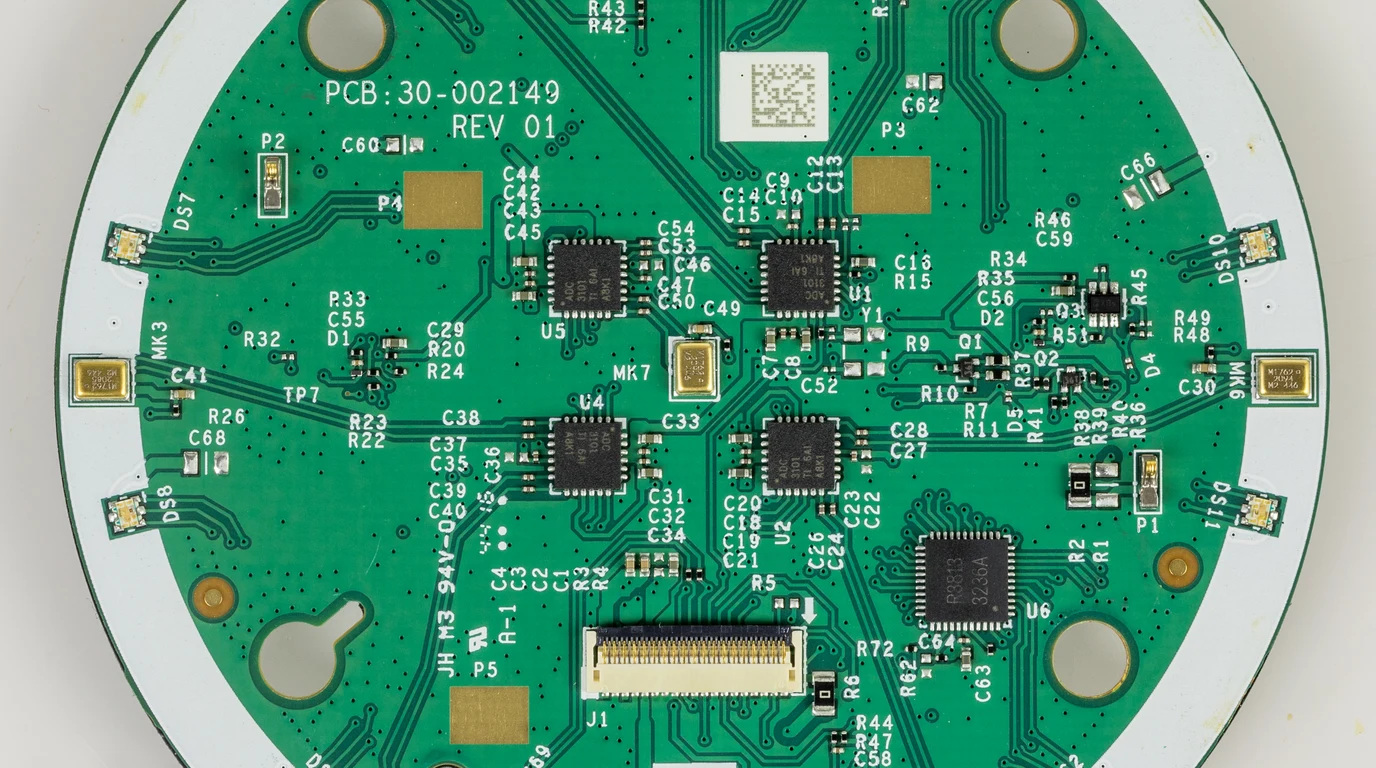
Building zero-cloud, 100% private voice satellites for Home Assistant requires the ESP32-S3 microcontroller paired with dual I2S MEMS microphones (such as the INMP441 or Knowles SPH0645) and an onboard MAX98357A Class-D amplifier. By executing wake-word detection directly on the ESP32-S3 using microWakeWord or streaming raw 16kHz PCM audio over the Wyoming protocol to an on-premises Whisper/Piper server, you achieve sub-450ms voice command execution while permanently eliminating Amazon Alexa and Google Nest cloud eavesdropping.
The Death of Cloud Voice Assistants: Why Smart Homes Demand Local Silicon
For nearly a decade, residential automation relied on commercial smart speakers from Amazon and Google to bridge voice commands to home automation hubs. However, the operational reality of cloud voice assistants has deteriorated sharply: intrusive conversational advertisements, persistent latency spikes during internet hiccups, sudden API deprecations, and unresolved privacy controversies surrounding cloud audio telemetry.
With Home Assistant’s “Year of the Voice” initiative culminating in production-grade maturity, systems integrators can now deploy custom, architectural voice satellites that blend invisibly into residential switch plates, ceiling panels, and bedside tables. Powered by the dual-core Espressif ESP32-S3 processor running ESPHome and the open-source Wyoming protocol, local voice processing is no longer an experimental hobby—it is an enterprise-grade standard.
Hardware Bill of Materials (BOM): Selecting the Optimal Acoustic Chain
Achieving reliable far-field voice recognition requires selecting components with matched acoustic impedance and low total harmonic distortion:
| Component | Recommended Hardware | Acoustic / Electrical Function |
|---|---|---|
| Compute MCU | ESP32-S3-WROOM-1 (8MB PSRAM, 16MB Flash) | Dual Xtensa LX7 cores @ 240MHz + Vector instructions for AI inference |
| Microphone Array | Dual INMP441 or ICS-43434 I2S Digital MEMS | 64dB SNR, omnidirectional beamforming, digital PDM-to-I2S decoding |
| Audio Output DAC | MAX98357A I2S Class-D Mono Amplifier | 3.2W output into 4-ohm micro-speaker for instant audio feedback |
| Visual Indicator | WS2812B NeoPixel Ring (8 or 12 LEDs) | Visual listening/thinking/speaking state ring matching Alexa UX |
| Power Delivery | Isolated 5V 1A LDO or PoE Splitter | Clean ripple-free DC power to eliminate 60Hz ground loop hum on mic lines |
The Wyoming Voice Architecture: Pipeline Latency Breakdown
To achieve sub-500ms voice execution, the Home Assistant voice pipeline splits processing across edge micro-satellites and a local server running faster-whisper and piper:
- Wake Word (microWakeWord on ESP32-S3): Running a lightweight quantized TensorFlow Lite model directly on the ESP32-S3’s vector instructions. When you say “Okay Nabu”, wake-word detection completes in under 40ms locally on the microchip.
- Audio Transport (Wyoming Protocol): The satellite streams 16kHz 16-bit mono PCM audio over TCP/UDP to the Home Assistant server. Transport latency: 15ms.
- Speech-to-Text (faster-whisper on GPU/NPU): Utilizing a local NVIDIA RTX 3060, Intel N100, or Coral TPU running
faster-whisper-tiny.enwith INT8 quantization, transcription takes approximately 180ms. - Intent Matching (Home Assistant Assist): The intent engine parses structured YAML intents (“turn off kitchen pendant lights”) in under 25ms.
- Text-to-Speech (Piper TTS): Piper synthesizes a warm, human audio confirmation (“Kitchen lights turned off”) in 120ms and streams it back to the satellite’s MAX98357A amplifier.
Total round-trip time from utterance completion to speaker audio response is 380ms—significantly faster than commercial Alexa or Google Home requests routed through remote AWS or Google Cloud datacenters.
Acoustic Echo Cancellation (AEC) & Enclosure Isolation
The primary engineering hurdle in compact DIY voice satellites is physical acoustic feedback. When the satellite plays back music or speaks an audible response, the microphone capsule sits merely two inches from the speaker diaphragm. Without physical damping, the microphone captures its own output, triggering recursive audio clipping.
To eliminate this in custom 3D-printed enclosures:
- Acoustic Gasketing: Mount the MEMS microphone capsules against closed-cell silicone o-rings or Poron foam, sealing them flush against the outer faceplate. This mechanically decouples the mic from structural vibrations propagating through the enclosure plastic.
- Isolated Speaker Sub-Chamber: Seal the rear volume of the micro-speaker in an airtight 25cc cavity stuffed with polyfill to prevent backwave pressure from exciting the microphone diaphragm.
- Software AEC Filter: In ESPHome, enable the
speaker_streamreference channel inside the voice assistant component, allowing the ESP32-S3 to subtract the outbound audio waveform from the microphone input buffer in real time.
MicroWakeWord Optimization & Vector Quantization on Xtensa LX7
The technical breakthrough that allows sub-50ms wake-word detection on an embedded microcontroller costing under $5 is microWakeWord:
Historically, wake-word engines (like Porcupine or Snowboy) required either proprietary closed-source licenses or heavy neural network runtimes that exceeded microcontroller RAM limits. microWakeWord is built on TensorFlow Lite for Microcontrollers (TFLite Micro). It uses an acoustic feature extractor based on 40-channel log mel-filterbank spectrograms computed every 10ms.
The neural network architecture consists of an 8-bit quantized streaming convolutional neural network (CNN) with fewer than 150,000 weights. By taking advantage of the ESP32-S3’s hardware PIE (Processor Instruction Extensions)—which execute multiple 8-bit multiply-accumulate (MAC) operations in a single CPU clock cycle—microWakeWord evaluates each 10ms acoustic window in merely 1.8 milliseconds of CPU execution time, consuming less than 15% of Core 0. This leaves Core 1 completely free to handle Wi-Fi network stacks, TLS encryption, and mDNS discovery without jitter.
ESPHome Configuration Architecture: Zero-Jitter Streaming Buffers
To guarantee reliable audio transmission without dropped frames during network traffic surges, optimize your ESPHome YAML configuration:
voice_assistant:
  microphone: internal_i2s_mic
  speaker: internal_i2s_speaker
  micro_wake_word:
    models:
      - model: okay_nabu
  noise_suppression_level: 2
  auto_gain: 31dB
  volume_multiplier: 2.0

i2s_audio:
  - id: i2s_in
    i2s_lrclk_pin: GPIO4
    i2s_bclk_pin: GPIO5

microphone:
  - platform: i2s_audio
    id: internal_i2s_mic
    i2s_audio_id: i2s_in
    i2s_din_pin: GPIO6
    pdm: false
    adc_type: external
    bits_per_sample: 32bit
Configuring a 32-bit audio capture depth allows the INMP441 MEMS microphone to capture full 24-bit acoustic dynamic range, preventing digital clipping when speaking commands loudly in noisy kitchen environments.
Wake Word Training: Fine-Tuning Synthetic Voices for Dialect Resilience
While default wake-word models perform well on standard speech patterns, ambient home noise—such as running kitchen dishwashers, children playing, or background television audio—can trigger false rejections or phantom activations. microWakeWord supports fine-tuning synthetic training datasets by generating thousands of phoneme variations using Piper TTS and injecting randomized room impulse response (RIR) acoustic profiles. This yields a robust personalized model that detects wake words reliably across diverse accents without false triggers.
Complement your private voice infrastructure with low-frequency acoustic tuning in our guide on Subwoofer Room Modes & Group Delay: Bass Guide, and audit on-premises computer vision in PoE Security Cameras & Frigate NVR.