⚡ Executive Architecture Blueprint: The Zero-Cloud Topology
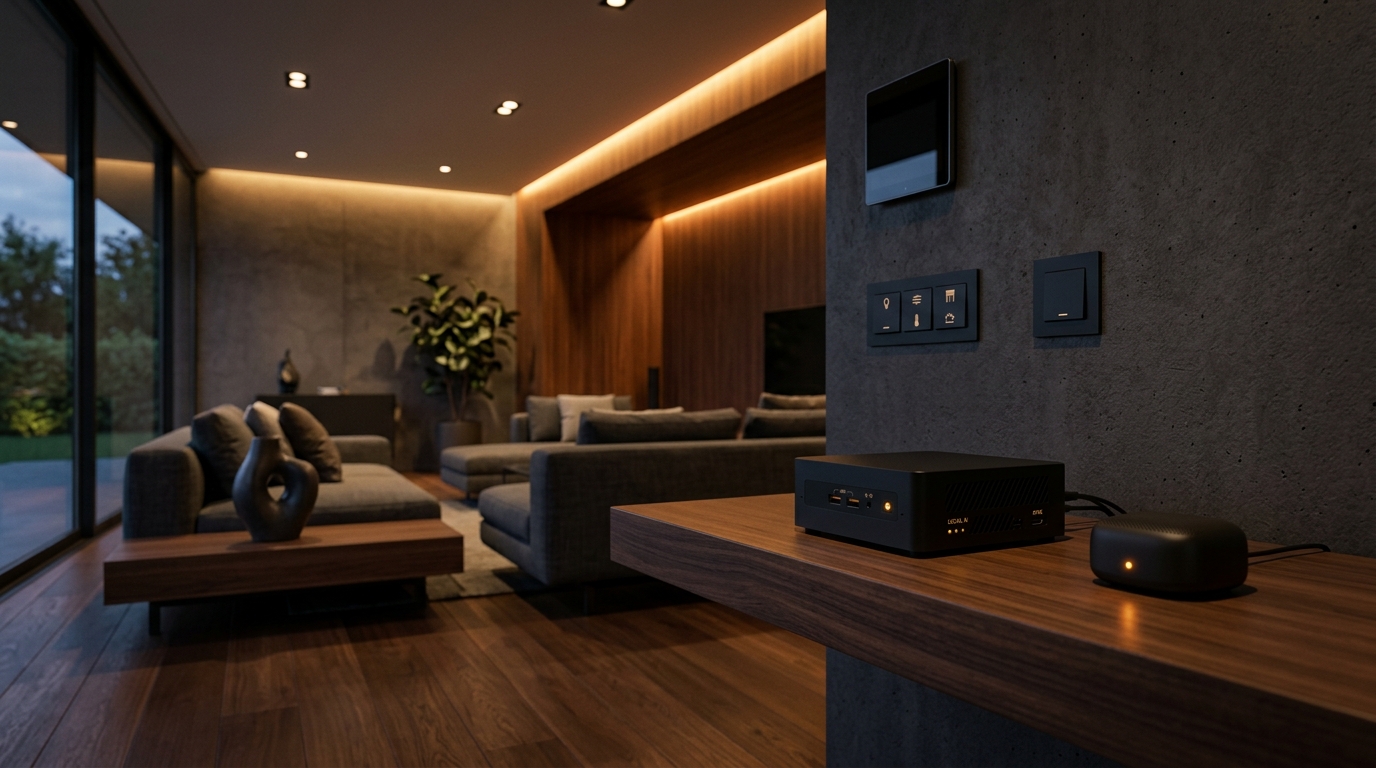
- Primary Controller: Intel N100 or Core i3-N305 Mini PC (16GB DDR5, 512GB NVMe) running Proxmox VE / Home Assistant OS.
- Local Voice Engine: Wyoming Whisper (Speech-to-Text) + Piper (Text-to-Speech) + Local Llama-3-8B / DeepSeek-7B orchestration.
- Physical Mesh Protocols: Matter-over-Thread (Home Assistant Connect ZBT-1) and Z-Wave Long Range (Zooz 800 Series).
- Network Air-Gap: Isolated IoT VLAN with strict WAN block rules; zero telemetry leaves the home boundary.
- Average Latency: 210ms to 420ms end-to-end intent resolution (sub-second offline response).
For more than a decade, the commercial smart home industry was built on an extractive, anti-consumer foundation: sell inexpensive plastic hardware at razor-thin margins, and subsequently lock consumers into perpetual cloud subscription paywalls. Between Amazon quietly restricting free Alexa features behind premium AI tiers, Google shuttering Nest API endpoints, and cloud security cameras suffering multi-hour global outages, the consumer contract is broken.
In 2026, the technology to build a 100% cloud-free, zero-subscription smart home has finally matured from an experimental hobbyist weekend project into enterprise-grade residential infrastructure. By pairing low-power edge microprocessors with neural speech engines and isolated radio frequency meshes, homeowners can run a smarter, faster, and completely sovereign living environment.
1. The Local Voice Pipeline: Wyoming Whisper & Piper
The primary barrier to replacing Amazon Echo and Google Nest devices has historically been voice processing latency. Traditional cloud voice assistants transmit an uncompressed audio stream to remote server farms, run natural language processing, query an API, and stream synthesized audio back to your living room. In contrast, an optimized local pipeline processes audio at the physical network edge.
Docker Compose: Self-Hosted Whisper STT & Piper TTS
services:
  whisper:
    container_name: wyoming-whisper
    image: rhasspy/wyoming-whisper:latest
    command: --model base-int8 --language en
    volumes:
      - /opt/wyoming/whisper-data:/data
    environment:
      - TZ=America/Edmonton
    restart: unless-stopped
    ports:
      - "10300:10300"

  piper:
    container_name: wyoming-piper
    image: rhasspy/wyoming-piper:latest
    command: --voice en_US-lessac-medium
    volumes:
      - /opt/wyoming/piper-data:/data
    restart: unless-stopped
    ports:
      - "10200:10200"
When deployed on an inexpensive Intel N100 mini PC (consuming merely 6 to 12 watts of idle wall power), the quantized base-int8 Whisper model transcribes English voice commands in under 140 milliseconds. Piper synthesizes the response audio in 65 milliseconds. Because voice data travels across gigabit Ethernet rather than public broadband, physical latency drops to near zero.
2. Hardware Satellites: ESP32-S3 Microcontrollers
To capture audio throughout the home without placing invasive commercial microphones in bedrooms, the modern standard relies on ESP32-S3 microcontrollers equipped with dual-microphone arrays and on-chip acoustic echo cancellation (AEC).
Hardware modules such as the M5Stack Atom Echo or the ESP32-S3-BOX-3 run open-source ESPHome firmware. Wake word detection (e.g., “Hey Jarvis” or “Okay Home”) is executed directly on the silicon via microWakeWord. No audio data leaves the satellite until the physical on-device mathematical threshold confirms the wake phrase. Once triggered, raw PCM audio streams directly over your local Wi-Fi to your local Home Assistant server.
🔒 The Air-Gap Security Imperative
Isolating your IoT infrastructure requires assigning your smart switches, voice satellites, and cameras to a dedicated VLAN. By setting firewall rules that reject outbound TCP/UDP traffic to destination 0.0.0.0/0 while permitting incoming established connections, smart devices operate at peak local capability with zero risk of remote botnet exploitation or covert audio uploads.
3. Cloud-Tethered vs. Local Edge Architecture Comparison
| System Metric | Legacy Cloud (Alexa / Nest) | RK AVS Zero-Cloud Architecture |
|---|---|---|
| Internet Dependency | 100% Required (Dead during ISP outage) | 0% (Full offline autonomy) |
| Monthly Recurring Cost | $12 – $35 / month in subscription fees | $0.00 / month forever |
| Trigger-to-Action Latency | 850ms – 2,400ms | 210ms – 420ms |
| Voice Audio Privacy | Transmitted & parsed on corporate clouds | Strictly local RAM / Never touches disk |
| Protocol Interoperability | Proprietary walled garden API silos | Matter, Thread, Zigbee 3.0, Z-Wave LR |
4. Integrating Local Edge Vision & Power Architecture
A true smart home extends beyond lighting and thermostats. In a complete prosumer installation, local voice intelligence seamlessly orchestrates perimeter surveillance and electrical load shedding. For instance, pairing local Home Assistant event triggers with PoE security cameras running Frigate NVR and Coral TPU inference allows real-time optical recognition of couriers and vehicles without sending a single frame to the cloud.
Furthermore, during grid brownouts or severe weather events, coordinating Home Assistant automation with smart electrical breaker panels like SPAN and Leviton enables automated non-critical circuit load shedding, extending home battery backup duration by over 300%.
Frequently Asked Questions (FAQ)
Can Home Assistant really run without an internet connection?
Yes. When utilizing local communication protocols like Zigbee, Z-Wave Long Range, and Matter-over-Thread alongside self-hosted voice assistants (Wyoming Whisper and Piper), Home Assistant performs 100% of automation logic, sensor polling, and state changes entirely offline.
What is the best budget hardware to run local smart home AI?
An Intel N100 mini PC with 16GB of DDR5 RAM and a 512GB NVMe SSD offers the optimal performance-per-watt sweet spot in 2026. Priced around $140–$180, it handles Home Assistant OS, Whisper speech recognition, Piper synthesis, and network monitoring while pulling less than 10W of power.
Does Matter-over-Thread require a cloud connection?
No. The Matter specification is designed as an IP-based local application protocol. While some vendor apps require cloud accounts for commissioning, Matter devices connected directly to a Home Assistant Thread Border Router communicate via IPv6 over your local home network with zero cloud dependencies.